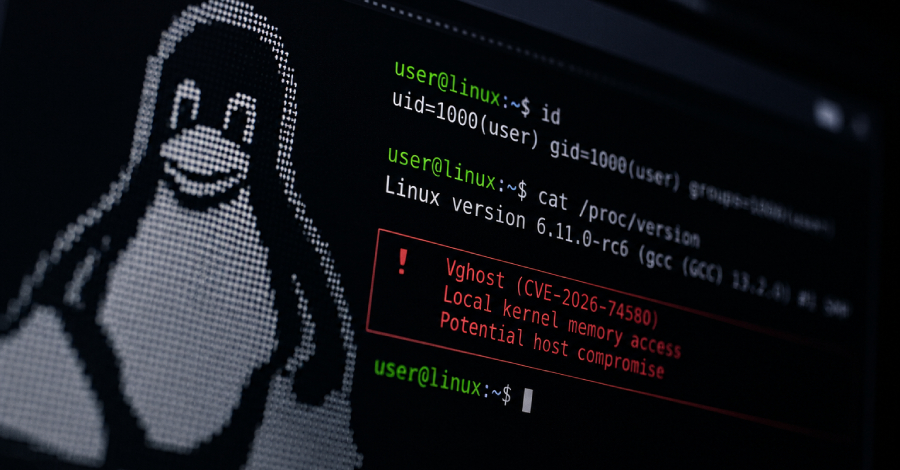
A flaw in Linux's vhost subsystem lets a local user read and write kernel memory at will and become root across nearly a decade of kernel versions. In one virtualization setup, it lets an untrusted virtual machine write to the host's memory and hijack the program that runs the virtual machine.
The bug is tracked as CVE-2026-74580 and named Vghost. Tencent Zhuque Lab, which found the flaw, released a fix on August 3 and published a full write-up on October 12 with working demos of both attacks. There is no public sign it has been exploited yet.
vhost is the part of the Linux kernel that speeds up network and other input/output for virtual machines and containers. A local user reaches it by opening a device node, usually /dev/vhost-net or /dev/vhost-vsock.
On the host, the flaw gives an unprivileged user a reliable way to read and write any kernel address, bypass KASLR, and escalate to root. The attack is deterministic: it needs no memory grooming and no lucky timing.
The second attack is narrower. When a virtual machine's virtio device is placed behind a virtual IOMMU with iommu_platform turned on, and vhost runs in device-IOTLB mode, an untrusted guest can trigger the same bug and make the host kernel write out of bounds into the host's QEMU process. From there, a guest can overwrite a function pointer in QEMU and take control of where the host process runs next, or crash it.
vhost keeps a small cache of the memory mappings behind each virtual ring and the shared queues it uses to move data.
Source link