Last week, carbon removal company Underground Forests became the first Dutch project developer to issue credits under a program labeled as CCP-eligible by the Integrity Council for the Voluntary Carbon Market (ICVCM).
The company celebrated the issuance of 3,249 carbon removal credits under the Rainbow Standard, which were generated through its long-term carbon storage in wooden pile foundations.
Each credit issued from these operations represents one tonne of atmospheric CO2 that was absorbed by trees. The carbon dioxide is now locked in wooden piles sitting below the groundwater table, in an oxygen-free environment that prevents the wood from decaying and releasing emissions.
Underground Forests has shared that the piles are in the ground under 19 buildings in Dutch construction projects, and every tonne of CO2 removal was independently verified by Normec Verifavia.
Following the credit issuance, the company also announced a multi-year offtake agreement with MinderCO2 that will serve to address MinderCO2’s 2025, 2026, and 2027 emissions.
Underground Forests’ approach to CO2 removal presents a climate-forward alternative to the concrete piles used for constructing buildings in the soft soils of the Netherlands.
As part of its operations, the company uses wooden piles from PEFC-certified forests in Belgium. Each wooden pile stores biogenic CO2 underground and this removal is then certified by Rainbow.
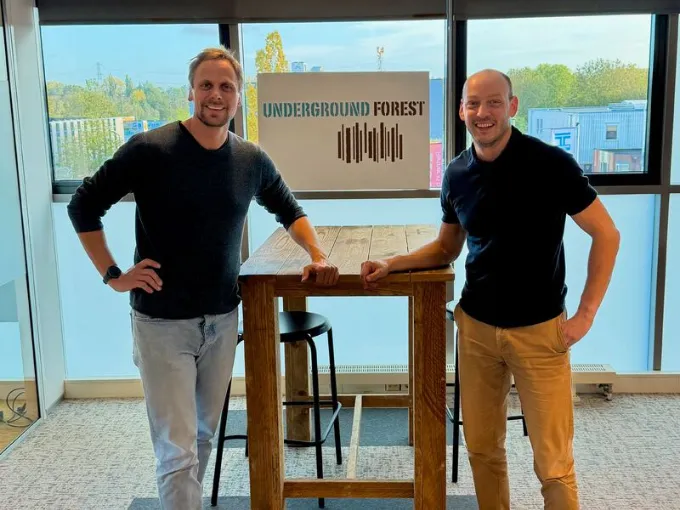
The company underlines that each of its wooden piles also avoids the emissions of a concrete pile, which is a co-benefit. “Every new building could store carbon instead of emitting it. That transformation starts at the very bottom, with the foundation,” says Kees de Gruiter, founder of Underground Forest.
Source link