
Most Western clean-energy reporting takes a very specific picture of home charging for granted. You pull into a private driveway, plug into an attached garage wall-box, and pull cheap power while you sleep.
Data from Kazam and the Alliance for an Energy Efficient Economy (AEEE) shows that roughly 70% to 75% of urban households in major Indian metros live in multi-family apartments and cooperative housing societies. Parking means an open ground level slot or a space two levels down in a concrete basement. When someone here buys an electric car, their biggest hurdle isn’t battery degradation or highway chargers. It’s their own building.
As an electrical engineer in India, I watch this play out every week. Someone buys an EV, assumes they can hire a local wireman to pull power from their flat’s meter to their parking bay, and runs straight into transformer limits, cable physics, and nervous managing committees.
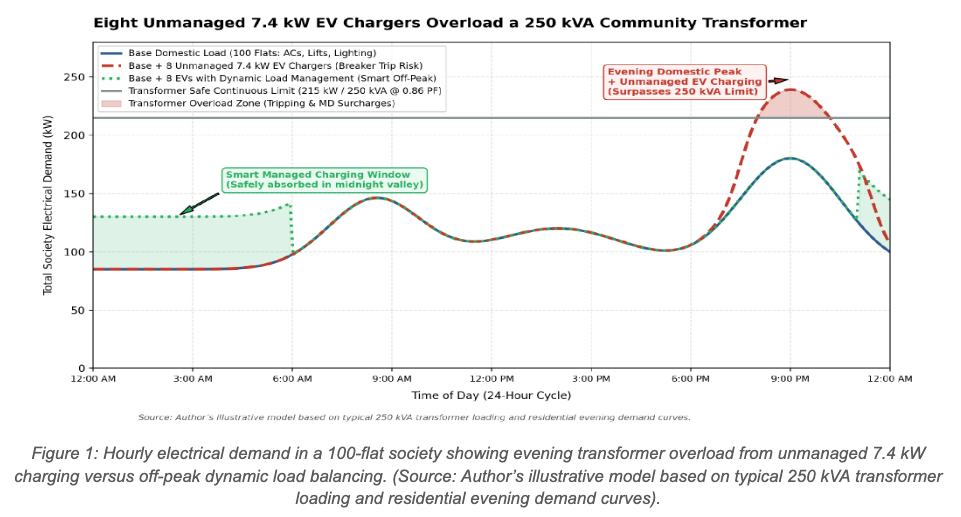
Indian housing societies buy electricity under a bulk “sanctioned load” from their local utility (DISCOM). The utility sizes the local transformer using an electrical diversity factor the simple assumption that not all 100 flats will run their air conditioners, geysers, and induction stoves at the exact same moment.
A domestic geyser pulls 2 kW for ten minutes and shuts off. 4 kW AC wall-box pulls 32 amps continuously for six to eight hours. When several residents plug in around 8:00 PM, that heavy, unbroken draw lands on the transformer right as domestic air conditioning and kitchen loads hit their evening peak.
Source link