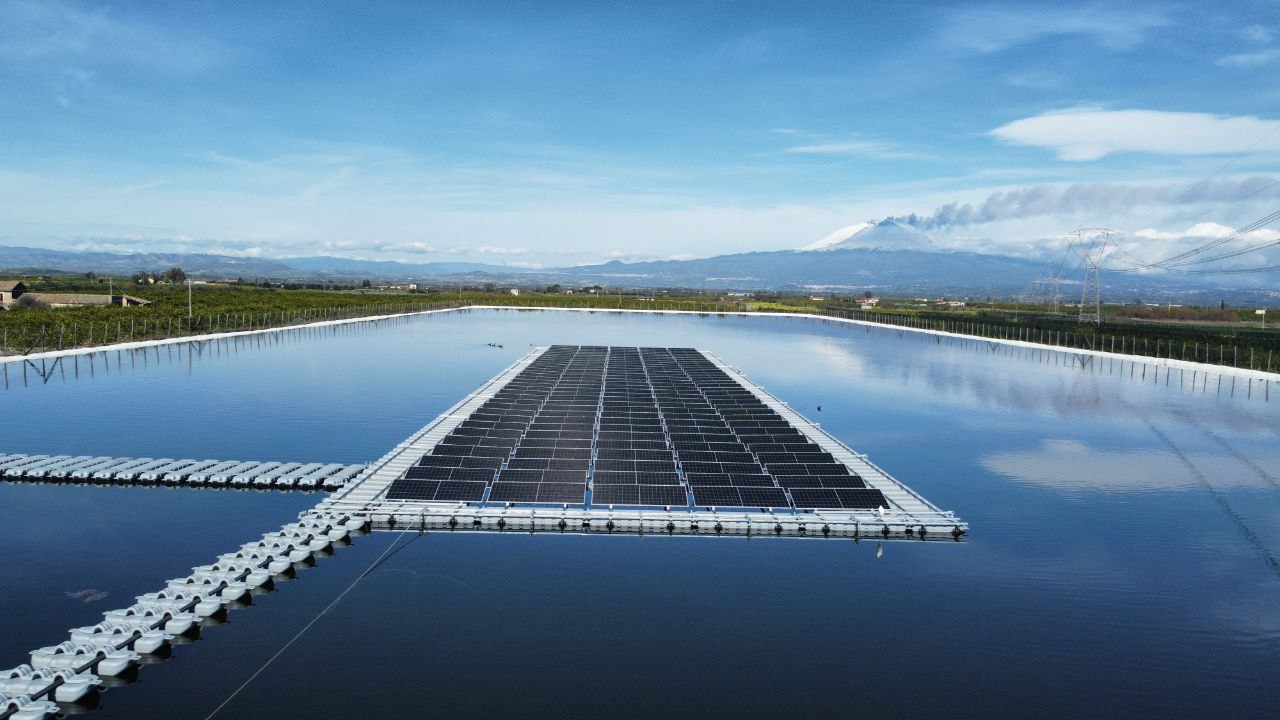
A computational fluid dynamics study of a proposed floating PV installation at the Occhito Dam reservoir in southern Italy has found that spacing module rows approximately 0.5 meters apart delivers the best cooling performance in a three-row configuration. The researchers found that the intermediate spacing outperformed both narrower and wider arrangements, highlighting the importance of airflow management in floating PV system design.
At a wind speed of 3.5 m/s, the optimal configuration achieved an average module temperature of 27.16 C, compared with 31.07 C for the most compact arrangement. Under weaker wind conditions of 1.5 m/s, the same configuration recorded an average module temperature of 37.02 C.
The study notes that the efficiency of crystalline silicon PV modules typically decreases by approximately 0.3% to 0.5% for every 1 C increase in cell temperature. The findings underscore the importance of airflow management in floating PV design and challenge the assumption that proximity to water alone ensures better cooling.
The researchers said row spacing should be considered not only in terms of installed capacity, shading, and floating platform requirements, but also as a key thermal design parameter.
The research, conducted by scientists from the University of Naples Parthenope and the University of Campania Luigi Vanvitelli, also identified a less intuitive aspect of floating PV cooling. Although the widest spacing allowed airflow to recover more fully between rows, it did not consistently produce the lowest module temperatures. The researchers attributed this to reduced airflow acceleration between rows.
The findings suggest that effective cooling requires a balance between aerodynamic wake recovery and airflow acceleration, with the optimal configuration depending on site-specific conditions.
Source link