This article has been reviewed according to Science X's editorial process and policies. Editors have highlighted the following attributes while ensuring the content's credibility:
All-solid-state lithium batteries require solid materials that allow lithium ions to move efficiently. Lithium borohydride (LiBH₄) is a promising material for this purpose because its high-temperature hexagonal phase supports rapid lithium-ion transport.
Introducing iodide into LiBH₄ can stabilize this conductive phase at lower temperatures, but producing smooth films with enough iodine has been difficult. Earlier methods added only about 8% iodine and often produced rough surfaces, limiting their usefulness in thin-film devices.
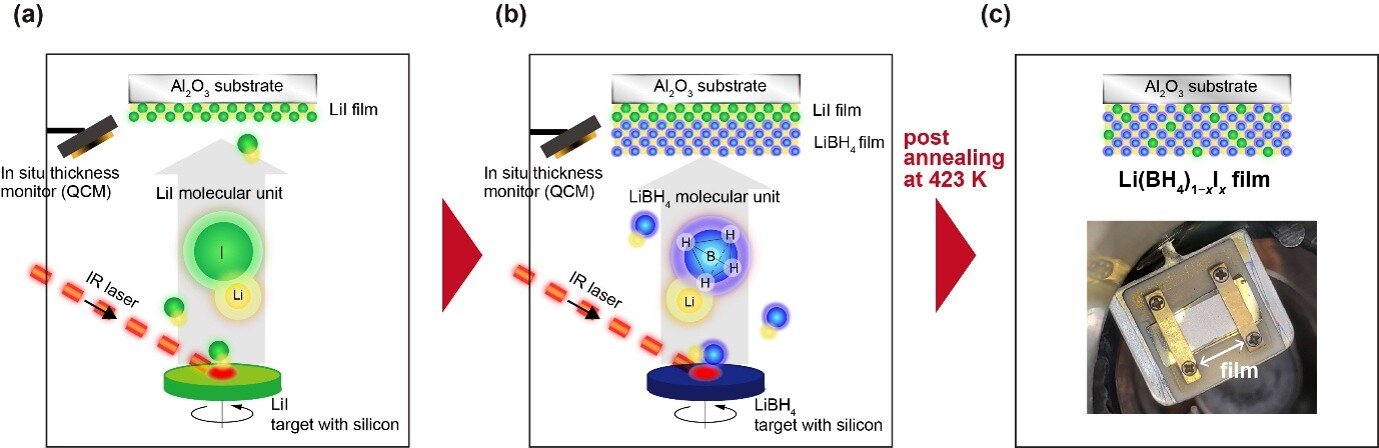
To address this challenge, a research team led by doctoral student Erika Fukushi and professor Hiroyuki Oguchi of Shibaura Institute of Technology in Tokyo, Japan, developed a multilayer method. They deposited thin layers of lithium iodide and LiBH₄ one after another at room temperature, then heated them so the layers could mix through interdiffusion. This approach allowed the researchers to add more iodine while keeping the films relatively smooth.
"By depositing LiBH₄ and lithium iodide separately, we can overcome the different vapor pressures that previously limited iodine incorporation," Fukushi says. "The multilayer design also lets us control composition through individual layer thicknesses while keeping deposition at room temperature, which helps suppress island-like growth seen in films deposited at higher temperatures."
After heating, the separate layers had largely mixed together, with SEM/EDS indicating extensive interdiffusion and large-area compositional homogeneity, although some local iodine-rich regions remained. 40), a substantial increase from the previous limit of about 8%.
Source link