This article has been reviewed according to Science X's editorial process and policies. Editors have highlighted the following attributes while ensuring the content's credibility:
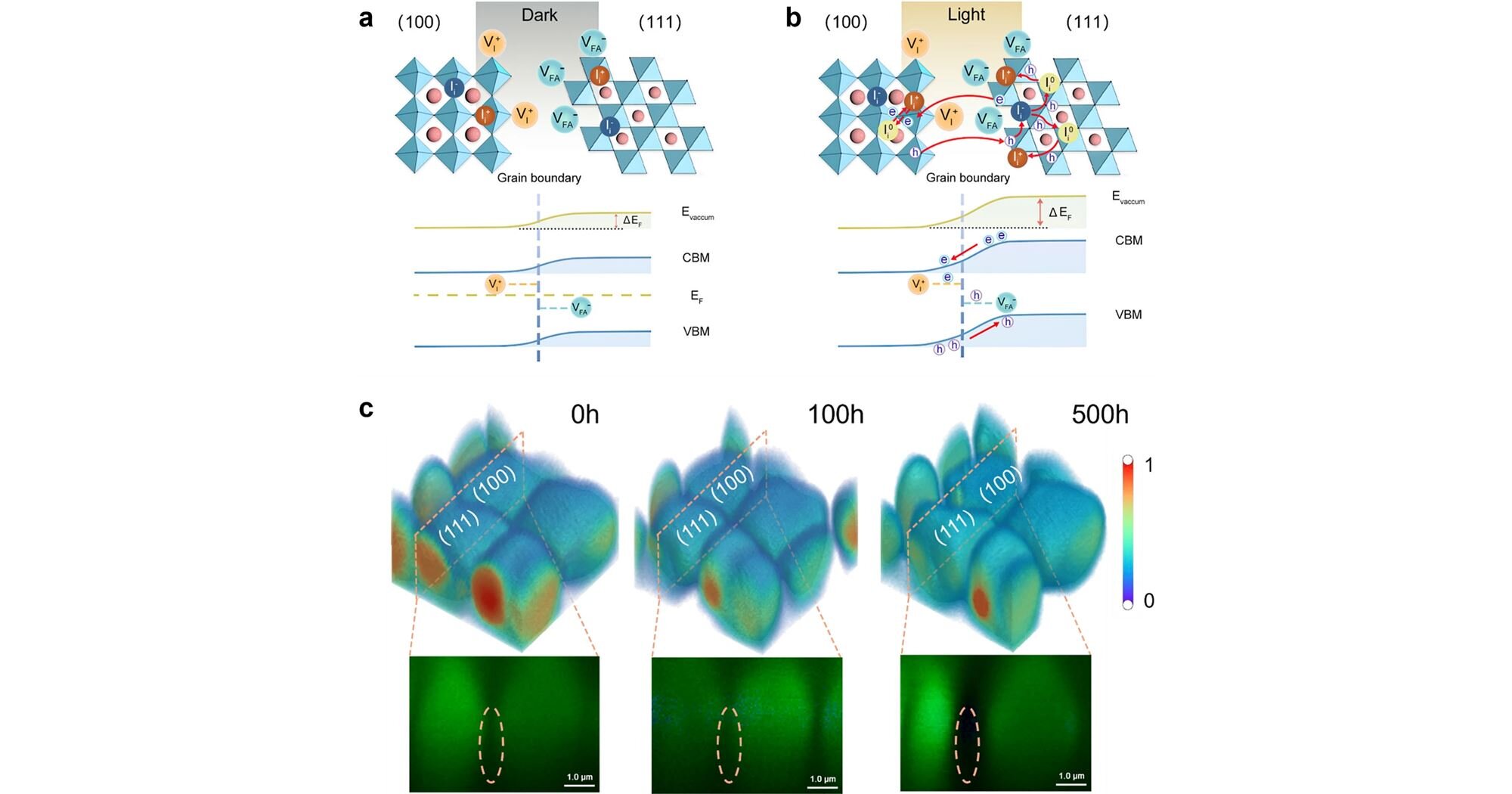
A research team at The Hong Kong Polytechnic University (PolyU) has found a previously overlooked cause of aging in perovskite solar cells exposed to light. The team has also developed a solution that effectively extends the cells' lifetime, an important step toward bringing the technology to market.
The study was conducted by Yang Guang, an assistant professor in the PolyU Department of Electrical and Electronic Engineering, together with a team from Zhejiang University, and has been published in the journal Watt. Professor Nam-Gyu Park of Sungkyunkwan University, Korea, a pioneer in perovskite photovoltaics, commended the work in a Research Highlight in the same journal.
Perovskite solar cells are efficient, low-cost, lightweight and versatile, and are widely seen as one of the most promising next-generation solar technologies. However, their performance gradually declines after long exposure to sunlight, a process known as photodegradation. Solar panels must work reliably outdoors for many years, so photodegradation has long been a major barrier to large-scale perovskite solar cell commercialization.
The layer of a perovskite solar cell that generates electricity comprises countless tiny crystals called grains. The surface of each grain has a particular orientation, known as its crystal facet. In mixed-facet perovskite solar cells, grains with different facets sit side by side. Each facet has its own properties, which can affect how charges move, how defects form and how the material ages under light.
Source link