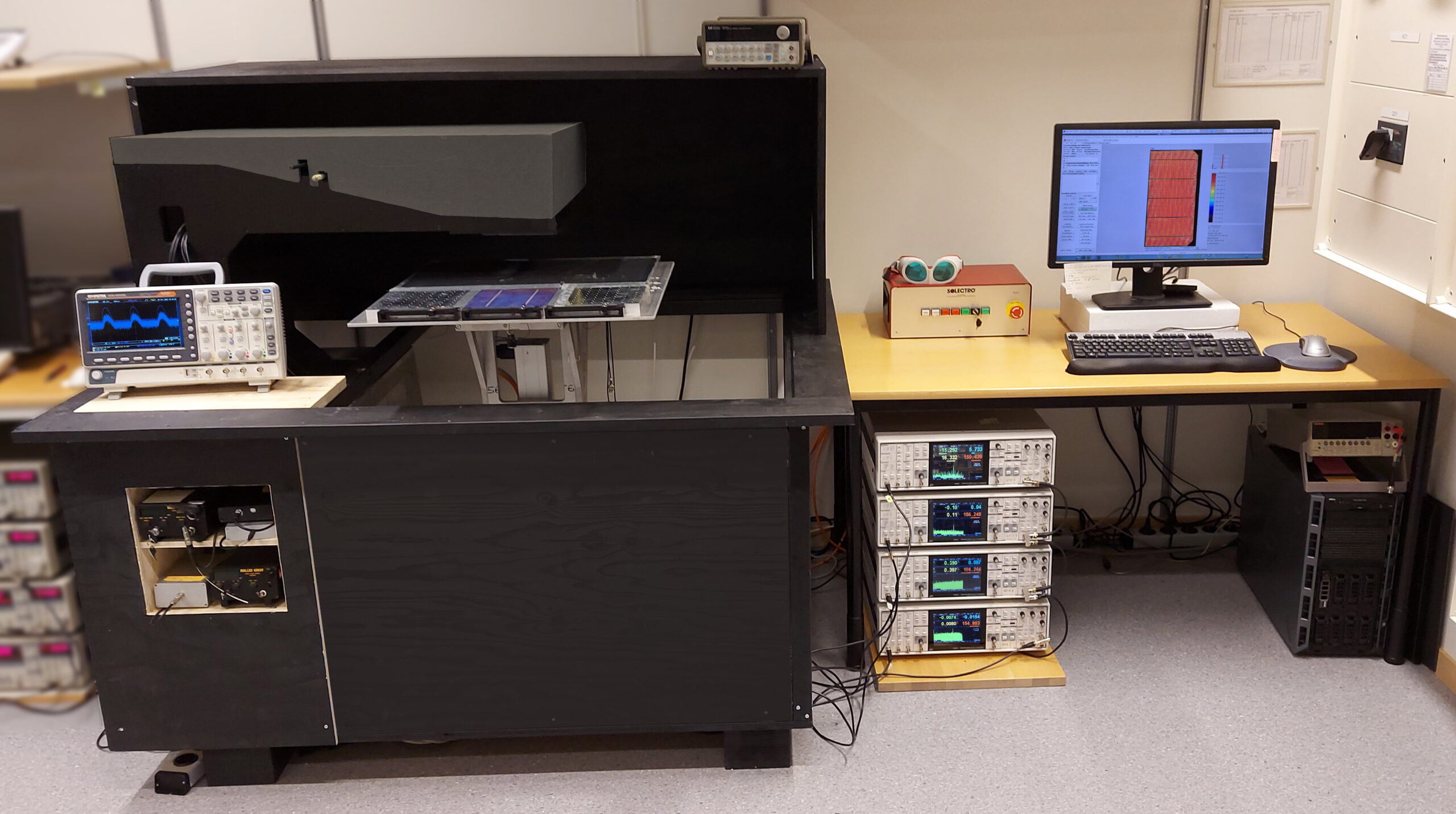
Researchers at Karlstad University in Sweden have used light beam-induced current (LBIC) phase mapping to investigate the local electrical behavior of half-cell solar modules and have found that the technique shows potential for assessing electrical contact quality and detecting localized defects with high spatial resolution.
LBIC mapping is a non-destructive, spatially resolved optoelectronic characterization technique used to investigate the electrical properties and performance of photovoltaic cells and modules. It involves scanning a focused light beam across a solar cell or module while measuring the resulting photocurrent to identify spatial variations in electrical performance.
Unlike conventional LBIC mapping, which primarily measures photocurrent amplitude, LBIC phase mapping uses modulated illumination to measure the phase shift of the photocurrent response, providing additional insights into local electrical resistance and contact quality.
“Our experiments demonstrated that LBIC phase mapping can detect variations in contact quality, including regions with good contacts and regions with intentionally reduced contact area and discontinuous wire contact,” corresponding author Markus Rinio told pv magazine. “The results demonstrate the potential of LBIC phase mapping as a sensitive local diagnostic technique for identifying variations in interconnection quality.”
“A central contribution of our work is the development of an analytical equivalent-circuit model and the derivation of an equation describing the relationship between the measured LBIC phase shift and the electrical parameters of the solar cell,” said co-author Majid Salari. “In particular, the equation establishes how changes in local series resistance (Rs) influence the phase response.
Source link