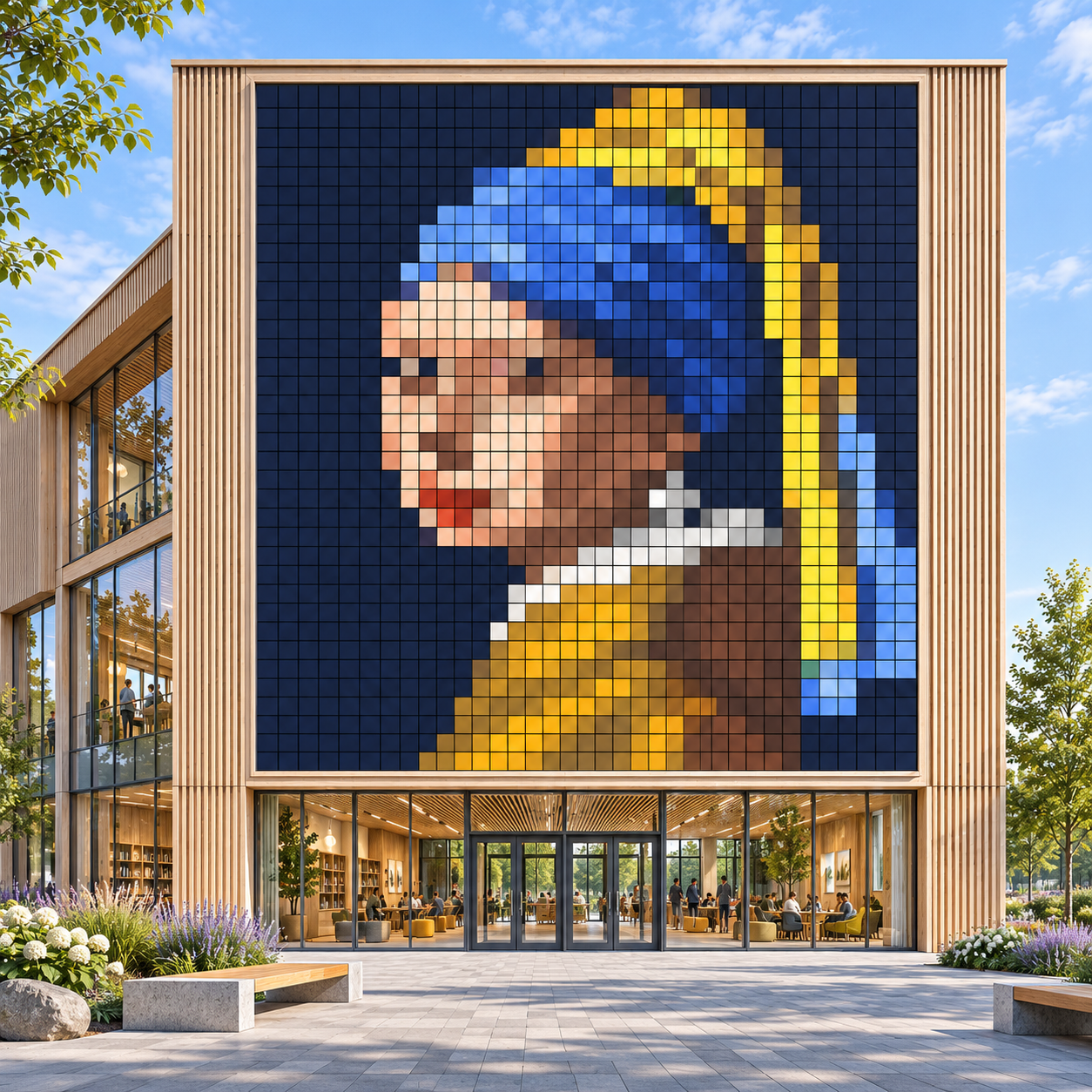
A South Korean research team has developed a novel model to predict power output and hot-spot risk in colored building-integrated PV (c-BIPV) systems featuring artistic images. The researchers modeled PV arrays displaying 50 masterpieces, including Johannes Vermeer’s Girl with a Pearl Earring and Vincent van Gogh’s Café Terrace at Night.
“Unlike a uniformly colored module, an image-based array contains many differently colored cells. Because each color requires a different optical reflection profile, the photocurrent generated by each cell can vary across the array,” corresponding author Hyung-Jun Song told pv magazine. “This spatial mismatch can reduce power output and, under certain bypass-diode configurations, expose cells to reverse bias and hot-spot risk.”
The novelty of the research, Song added, lies in directly linking the visual characteristics of a candidate image to the electrical performance and reliability of the entire PV array. “For every pixel, we estimated the minimum-loss selective-reflection spectrum needed to reproduce its color and calculated the resulting photocurrent. We then used equivalent-circuit simulations to evaluate the series-connected array under different bypass-diode configurations,” he explained.
In its work, the group has converted each of the 50 artworks into a 36 × 36-pixel mosaic, with each of the 1,296 pixels representing an individual series-connected PV cell. They assigned each pixel the average color of its corresponding image region. For each color, they calculated an ideal dual-band selective-reflection spectrum, selecting the reflection-band parameters that most closely reproduced the target color. They then calculated the photocurrent generated from the sunlight transmitted through the colored layer, accounting for the underlying cell’s wavelength-dependent internal quantum efficiency.
Source link