The US Department of Energy (DOE) has selected OpenStar Technologies and Columbia University to design the world’s first exhaust system for a levitated dipole fusion reactor.
Commercial nuclear fusion relies on trapping superheated gas—known as plasma—inside magnetic fields. However, every reactor must safely clear away heat and stray particles before they melt the machine’s interior walls. Typical fusion devices solve this using a “divertor,” which guides escaping plasma onto cooled target plates.
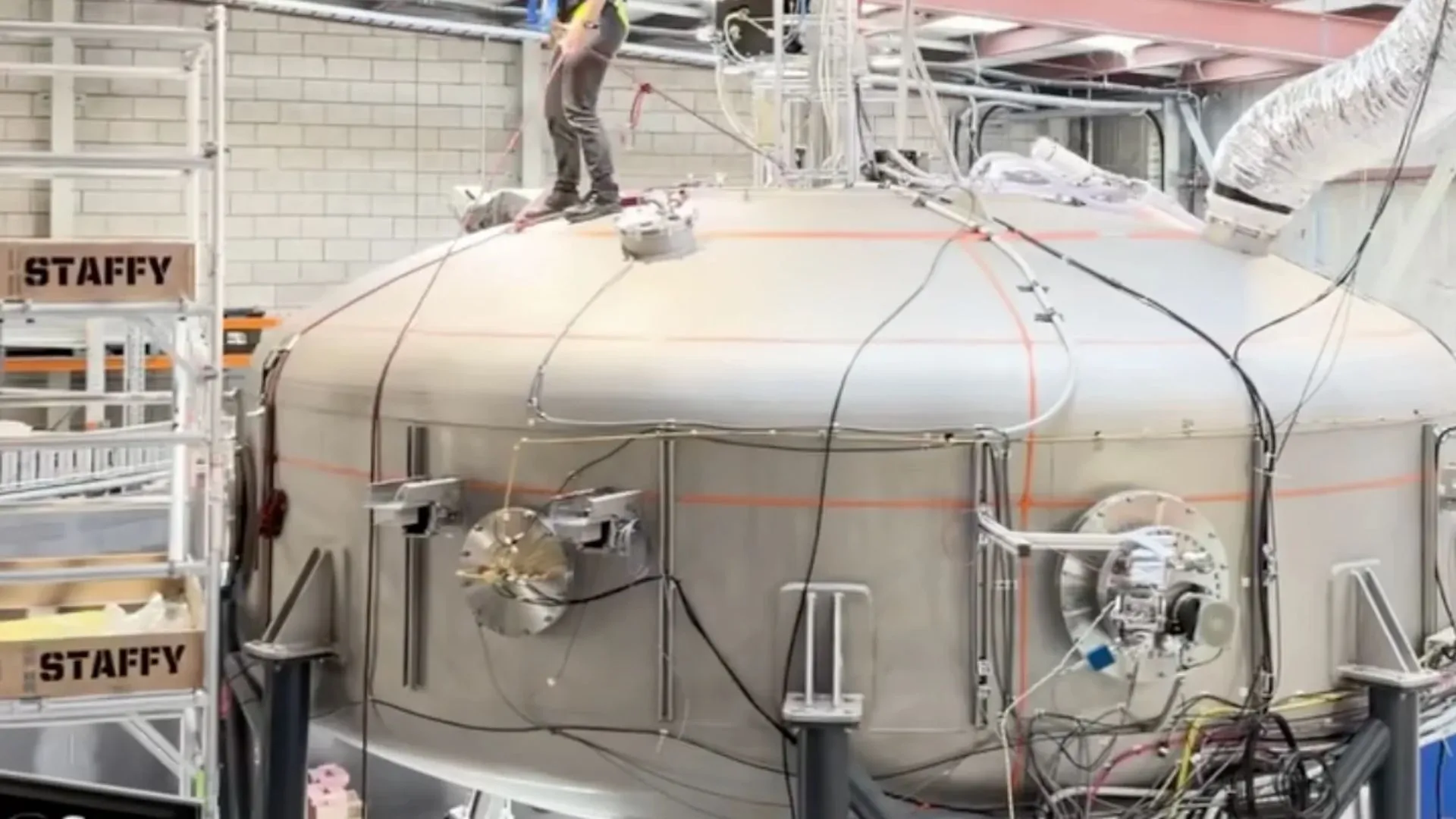
No divertor has ever been built for a levitated dipole. Unlike conventional doughnut-shaped reactors that surround plasma with massive external magnets, a levitated dipole floats a single superconducting magnet inside a vacuum chamber. This mimics the natural magnetic fields of planets like Earth and Jupiter. Removing physical support struts eliminates a major pathway for heat to leak out, keeping the plasma stable.
“The magnetic dipole is an elegant and remarkably simple fusion concept that remains largely unexplored,” said Prof. Ben Zhu, an assistant professor at Columbia Engineering. “A viable exhaust solution is among the most pressing challenges facing any fusion energy system, so what we learn here will contribute directly to the broader pursuit of commercial fusion power.”
Over the next 12 months, researchers will map how heat and particles behave at the edge of a dipole’s magnetic field. This geometry creates a true magnetic field null, known as an X-point. It forces engineers to look beyond standard reactor models.
To do this, Columbia will pair two advanced software tools: TokaMaker and an open-source edge-modeling code called Hermes-3.
Source link