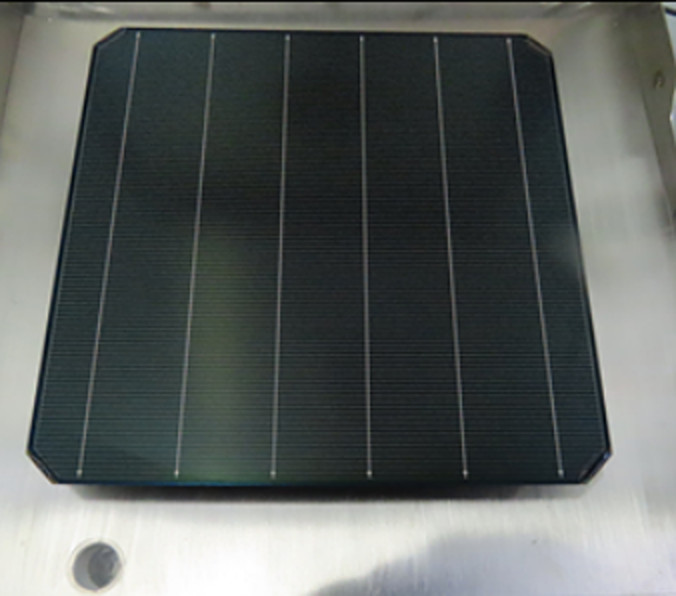
Researchers at Chinese solar manufacturer Longi have investigated the physical mechanisms behind edge masking in high-efficiency solar cells, finding that the technique suppresses edge recombination by restricting lateral carrier transport.
Edge masking is a laboratory measurement technique in which the perimeter of a solar cell is covered with an opaque material to prevent illumination of its edges, thereby reducing recombination losses and potentially increasing measured conversion efficiency.
“Our starting point was a practical concern about how efficiencies are measured,” Longi researcher Genshun Wang told pv magazine. “In an earlier study on high-efficiency back contact cells, we found that the wafer edge was a major channel of current loss, and that masking the edge during testing appreciably raised the measured efficiency – 26.74% over the total area versus 27.09% over the designated illumination area.”
Wang explained that although edge masking is widely used in record solar cell efficiency measurements, particularly for small-area devices, its underlying physical mechanisms have not been fully understood.
“Earlier work had treated the masked region as geometric shielding, or as a parallel dark sink in a lumped equivalent circuit, with little said at the carrier-transport level,” he said. “Clarifying it provides design guidance, as it allows the optimum masking width to be quantified so that a suitable grid design can deliver a higher masking gain.”
In the paper “ The influence of edge masking on the optoelectronic performance in back contact silicon solar cells ,” published in Solar Energy Materials and Solar Cells , the researchers demonstrated that masking creates a dark, electrically resistive region that limits carrier movement toward the cell perimeter.
Source link