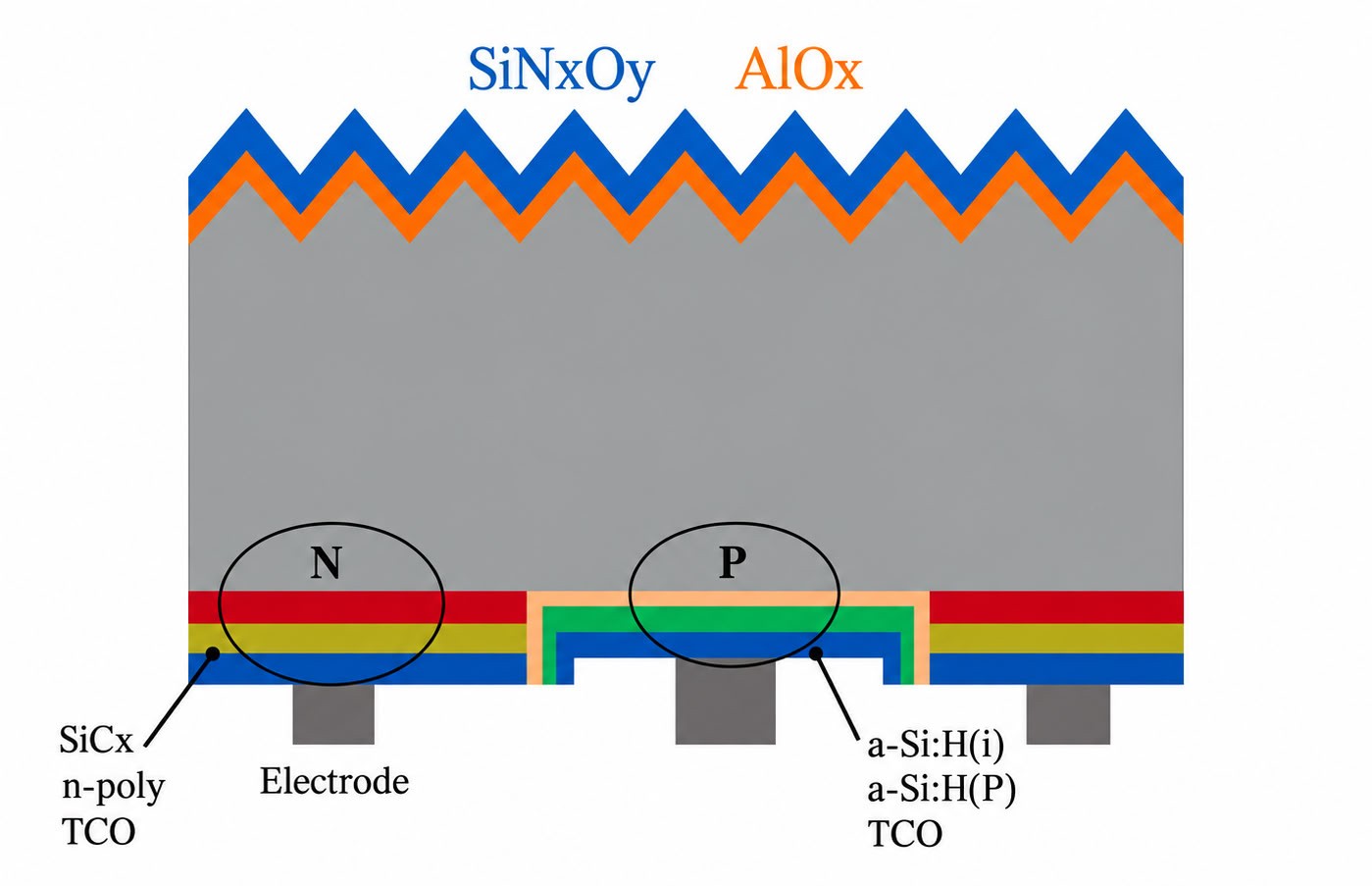
Chinese PV module maker JinkoSolar unveiled its TOPCon-based Amorphous-Si Passivating Cell (TAC) technology at its Global Tech Day event in Shanghai on Oct. 17. According to a technical white paper published by the company, the architecture combines TOPCon electron-selective contacts with heterojunction (HJT) hole-selective contacts and a rear-electrode layout.
The design uses an n-type crystalline silicon wafer with two alternating carrier-selective contact regions on the rear surface. Both positive and negative electrodes are located on the rear, eliminating front-side metallization and the associated optical shading losses.
The electron-collecting n-type region retains the contact structure used in TOPCon cells, consisting of an approximately 1 nm to 2 nm silicon oxide tunneling layer and heavily doped polycrystalline silicon. This structure enables selective electron transport with low contact resistance while suppressing carrier recombination.
The hole-collecting p-type region uses intrinsic and doped hydrogenated amorphous silicon (a-Si), drawing on HJT cell technology. JinkoSolar said the configuration improves surface passivation and open-circuit voltage. A transparent conductive oxide (TCO) layer facilitates lateral carrier transport, while the amorphous silicon passivation process takes place at temperatures below 200 C.
High-precision laser patterning and dielectric isolation separate the two contact regions. JinkoSolar describes the architecture as a “2+1” design, combining TOPCon electron contacts, HJT hole contacts and a rear-electrode structure.
TAC belongs to the broader back-contact (BC) cell category, which includes architectures using different passivation and carrier-selective contact technologies. Unlike conventional front-contact TOPCon cells, TAC eliminates front-side metal contacts to reduce shading losses. Its distinguishing feature among BC technologies is the integration of TOPCon and amorphous silicon heterojunction contacts on the same wafer.
Source link