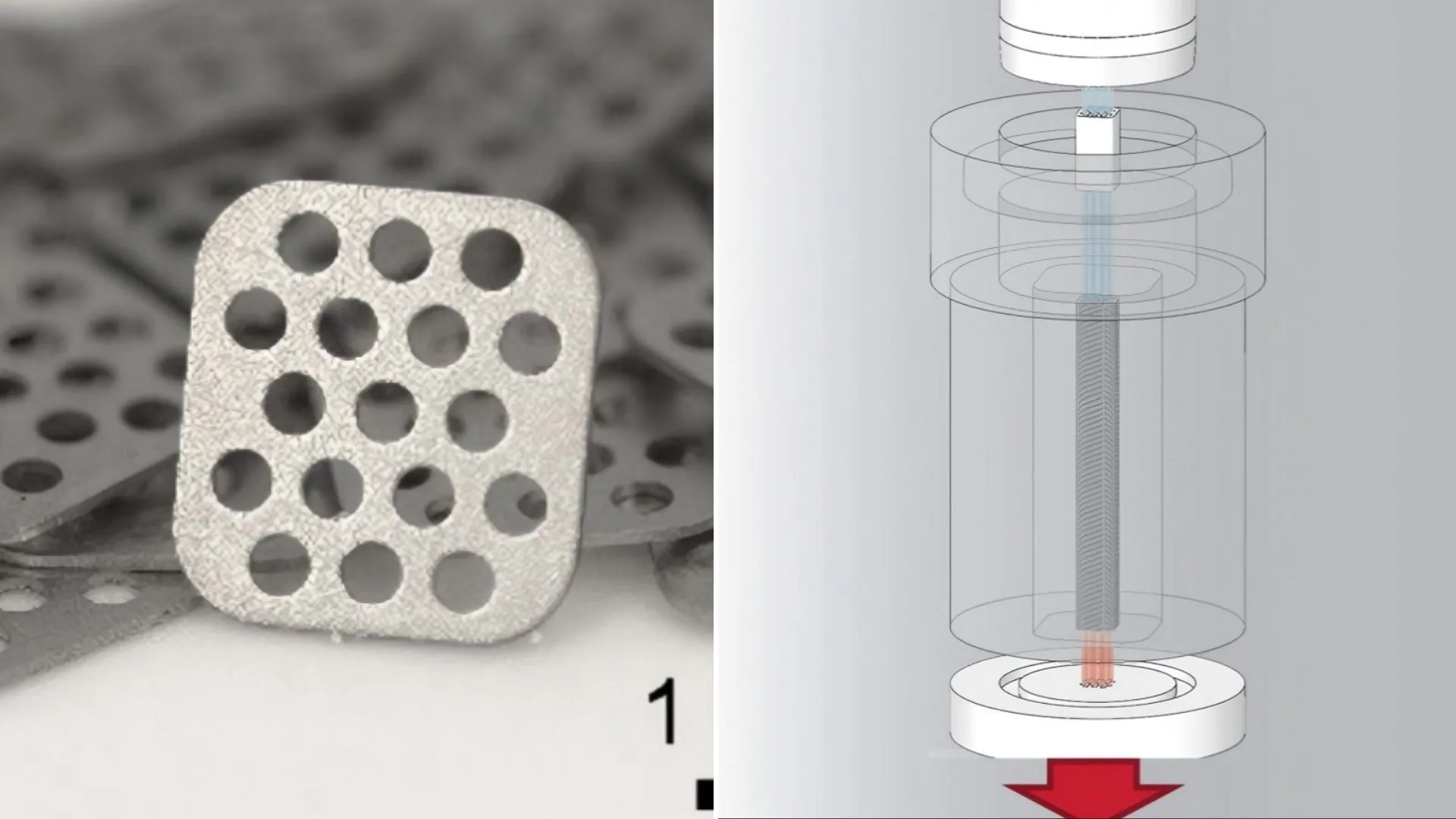
Researchers at the Hong Kong University of Science and Technology (HKUST) have developed a low-cost refrigerant structure for solid-state cooling that survived more than 100 million operating cycles in tests. Inspired by honeycomb-like architectures, the design could help address two major barriers to elastocaloric refrigeration: manufacturing costs and mechanical durability.
The structure uses thin sheets of nickel-titanium (NiTi), a shape-memory alloy, stamped into porous chips and stacked to form a tubular refrigerant unit. The team estimates it could last more than 10 years under the tested operating conditions.
The findings, published in Science under the title “Stacked porous NiTi structure with low cost and ultrahigh fatigue life for elastocaloric cooling,” offer a potential route to producing elastocaloric cooling components at a scale and cost more suitable for commercial applications.
Conventional air conditioners and refrigerators generally use vapor-compression systems, which circulate refrigerants through a cycle of compression, condensation, expansion, and evaporation. These systems consume substantial energy, while some refrigerants can contribute significantly to global warming if released.
Elastocaloric cooling takes a different approach. It uses shape-memory alloys that undergo reversible changes in their internal crystal structure when subjected to mechanical stress.
When a suitable alloy is compressed or stretched, this transformation releases heat. Removing the stress reverses the process, allowing the material to absorb heat. Repeating this cycle, alongside a system that transfers heat in and out of the material, produces a cooling effect without conventional refrigerants.
However, developing practical components remains challenging. They must withstand repeated mechanical loading while providing sufficient surface area for efficient heat exchange .
Source link