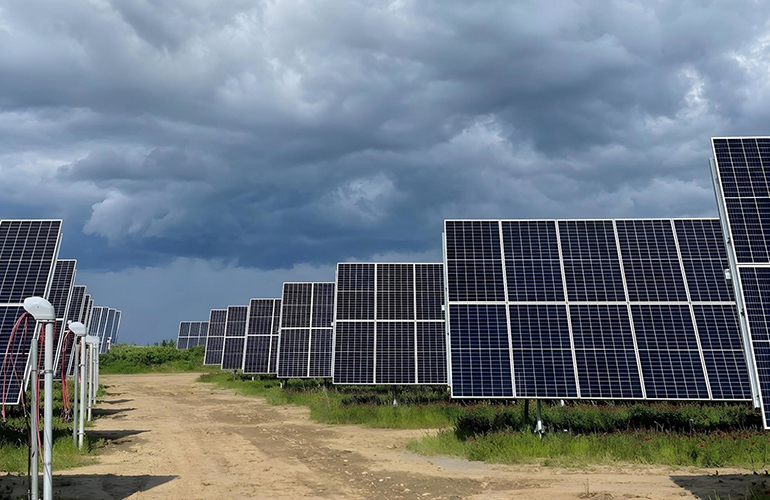
Researchers at Nanchang Hangkong University in China have developed a dual silicon oxide (SiOₓ) diffusion barrier strategy to improve the efficiency of tunnel oxide passivated contact (TOPCon) solar cells. The approach combines post-plasma oxidation with tunnel oxide optimization to control the depth distribution of electrically active phosphorus and the microstructure of polysilicon (poly-Si).
“Conventional industrial TOPCon optimization mainly focuses on adjusting the total phosphorus dose or tunnel oxide quality, without independently controlling the position of the electrically active phosphorus peak within polysilicon,” corresponding author Wenhao Chen told pv magazine. “Phosphorus accumulation at the surface increases parasitic optical absorption without further reducing contact resistance, creating a trade-off between contact and optical losses in mass-produced cells.”
“Our work demonstrates an industry-compatible dual-SiOₓ diffusion barrier approach based on post-plasma oxidation,” Chen explained. “Rather than physically redistributing phosphorus atoms, inward-diffusing oxygen induces depth-selective dopant deactivation through the formation of electrically inactive P–O complexes. Extending post-plasma oxidation to 100 seconds shifts the activated phosphorus peak from the poly-Si surface to a depth of approximately 50 nm, closely matching the silver paste burn-off depth during screen-printing and co-firing.”
“Combined with a densified bottom tunnel oxide barrier, this dual-oxide confinement maintains high dopant activation and excellent passivation quality,” Chen said. 07 percentage points. The improvement mainly results from reduced contact resistivity and suppressed parasitic absorption, with only minor degradation in open-circuit voltage.
Source link