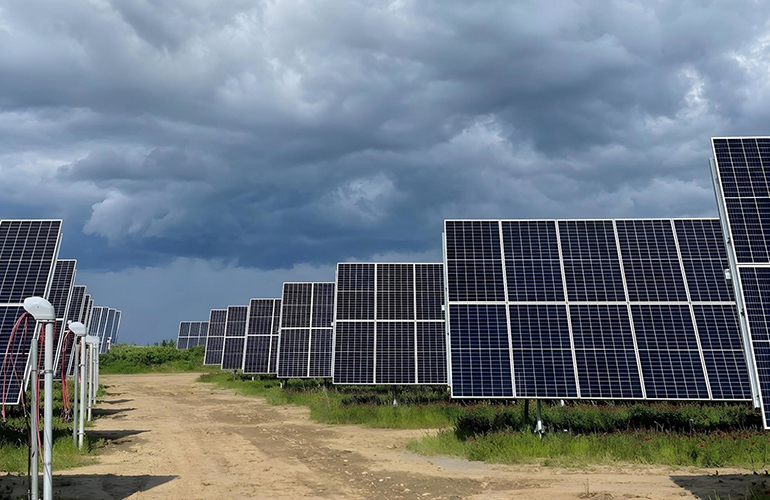
Chinese solar manufacturer DMEGC has unveiled a new series of bifacial glass-glass photovoltaic modules featuring a steel frame designed to improve mechanical reliability and rear-side power generation.
“The zinc-aluminum-magnesium (Zn-Al-Mg) coated steel used in the frames has nearly twice the tensile strength of conventional aluminum alloys, enabling the modules to withstand snow loads of up to 6,000 Pa and wind loads of up to 5,000 Pa when installed with suitable mounting systems,” a spokesperson from the company told pv magazine.
DMEGC said the material also has a lower coefficient of thermal expansion, compared with aluminum and glass. The closer thermal expansion characteristics of steel and glass could reduce mechanical stress and the risk of cell microcracks during temperature fluctuations, the company said.
The frame features an S-shaped cross-section that reportedly reduces vertical shading on the rear side of the module by 76% compared with conventional frame designs. DMEGC said the geometry increases the unshaded rear-side area by 3.6%, resulting in a theoretical improvement in bifaciality of approximately 2.8%.
The new Infinity RT 3.0 series comprises six models with power outputs ranging from 640 W to 665 W and efficiencies between 23.7% and 24.6%.
The DMxxxG12RT-B66HSW 640~665W modules are based on 132 n-type monocrystalline half-cut cells and measure 2,382 mm × 1,134 mm × 30 mm, with a weight of 33.3 kg. They feature 2 mm heat-strengthened glass on both sides and are designed for utility-scale PV applications.
The modules achieve a bifaciality factor of up to 85%, according to the manufacturer.
Source link