
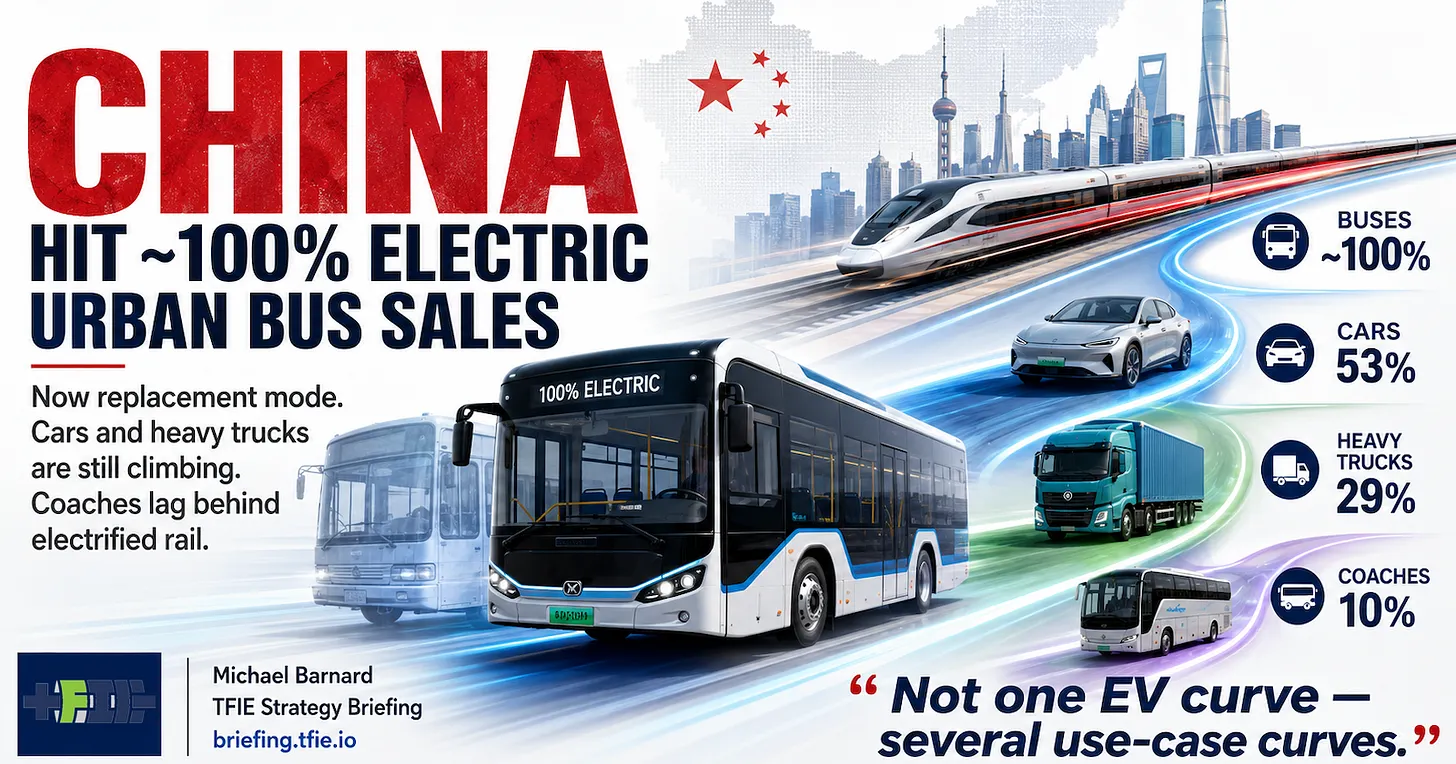
China has reached a stage of vehicle electrification that is easy to miss if the only number being watched is national EV market share. New urban buses are now essentially all electric, and in many cities the procurement question is no longer whether to replace a diesel bus with a battery bus. It is which new electric bus should replace the electric bus bought during China’s first major electrification wave.
That is a more important milestone than another record year of EV sales because it shows a transport segment completing its first adoption cycle and entering routine replacement. The International Energy Agency estimates that almost 70% of China’s more than 680,000 electric buses were already deployed before 2020, so a significant part of the current market consists of older electric fleets being renewed rather than diesel fleets being converted for the first time.
China’s 2025 equipment-renewal programme explicitly supported replacement of new-energy city buses and even complete traction-battery replacement, with the programme continuing into 2026. Policy is still involved, but its job has changed. It is supporting renewal inside a market where electric propulsion has already become the normal technology.
That replacement cycle is the starting point of my TFIE Strategy Briefing analysis of China’s electric transport markets. Looking across buses, cars, heavy trucks and coaches shows why “China’s EV adoption rate” is increasingly the wrong denominator.
Passenger cars are at a different point. Electric cars accounted for just over half of Chinese new-car sales in 2025, and buyers had nearly 700 electric models available by the end of the year.
Source link