This article has been reviewed according to Science X's editorial process and policies. Editors have highlighted the following attributes while ensuring the content's credibility:
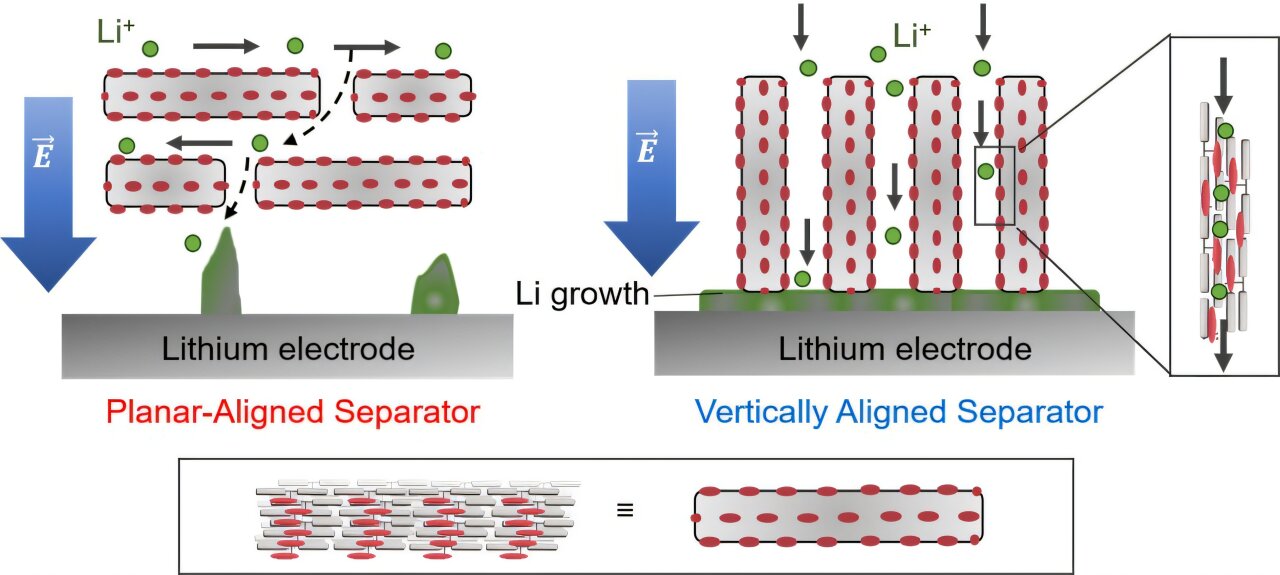
When using electric vehicles or smartphones, users often experience inconvenience from long charging times and gradually shortening battery life. To increase charging speed and extend usage time, next-generation batteries with high energy density are essential. However, fast charging has had limitations because deposits can accumulate inside batteries, degrading performance and even increasing the risk of fire. A Korean research team has developed a new foundational technology to address this problem by creating a "highway" through which lithium ions can move rapidly inside a battery.
The team led by professors Dong Ki Yoon and Hye Ryung Byon from the Department of Chemistry developed a next-generation battery separator technology that precisely controls lithium-ion transport pathways by regulating the molecular alignment of liquid-crystalline polymers. Their findings are published in the journal ACS Nano.
Lithium metal batteries can store more energy than conventional batteries. However, during charging, lithium can accumulate in sharp, branch-like structures known as "dendrites." This phenomenon has been a major cause of reduced battery life and can damage the internal separator, potentially leading to explosions.
The research team sought to solve this problem using liquid crystal materials , which combine the ordered characteristics of solids with the fluidity of liquids. Because the orientation of liquid crystal molecules can be altered through surface treatment and other methods, the researchers used this property to regularly align the pathways through which lithium ions travel.
Source link