Physical AI is changing how chips are designed and used, integrating sensing, AI inference, and real-time control into machines that can safely and predictably interact with the physical world.
The challenges extend well beyond just performance. Engineers need to account for corner cases stemming from unpredictable environments, ensure these systems are safe and reliable, and they need to future-proof these systems by ensuring they are serviceable and upgradable. This will require new tools and methodologies, as well as some new design approaches.
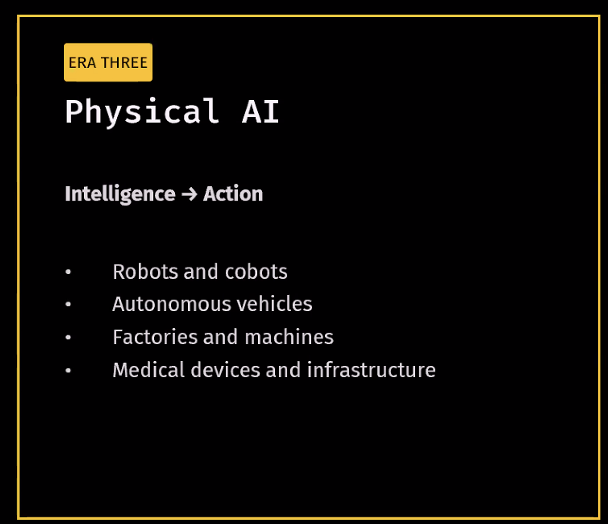
“AI is leaving the screen,” says Anthony Matarazzo, head of physical AI, digital twins, simulation-driven AI, and accelerated computing at Synopsys. “It is no longer about generating text or code. It is entering the physical world. It needs to understand, interact, sense, make decisions in a physical environment. We are moving from generative AI to agentic workflow orchestration to physical AI (see figure 1.) That is literally making intelligence actionable. But the consequences of being wrong fundamentally change. Life or death, plus or minus 1%.”
Physical AI must see and interact with the real world. “It is challenging to make artificial intelligence see the world correctly,” says Chun-Ting “Tim” Wang-Lee, signal integrity application scientist at Keysight EDA. “Real-world information comes from the sensors, and the data has to be moved somewhere and processed so that the AI can decide and then act. There are decisions that need to be made.”
This changes the design priorities. “Physical AI usually gets framed as a compute story,” says Justin Endo, director for marketing and sales at Mixel , A Silvaco Company.
Source link