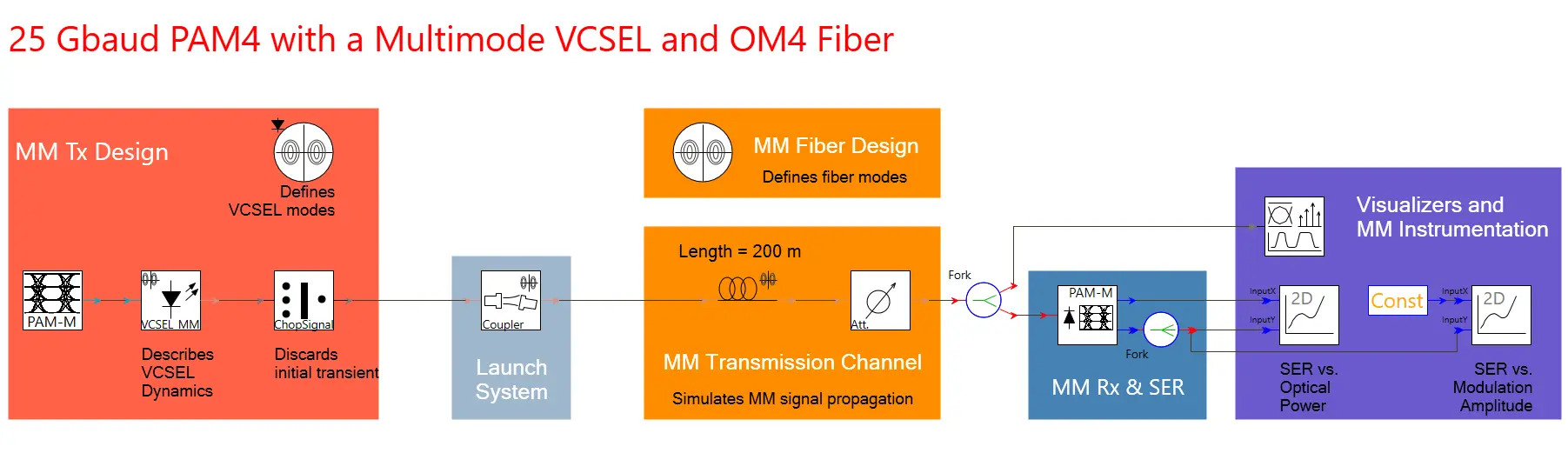
A laser has its own performance requirements. So does an optical fiber. The interface between them introduces another set of variables. Ultimately, those individual components have to perform together as part of a complete optical link.
If the individual pieces meet their design targets, will the complete system perform as expected?
A Keysight EDA-Photonics Design (VPIphotonics) study of short-reach datacenter links provides a useful example. Two multimode VCSEL channels were designed with comparable signal characteristics and evaluated with a wideband multimode fiber. Yet when evaluated as complete transmission links, the two channels produced different results.
The VPIphotonics study modeled 26.5625 GBaud PAM4 transmission over 150 meters of wideband multimode fiber, using VCSEL channels operating at 850 nm and 910 nm. Each VCSEL was modeled with four transverse modes, and the link considered coupling conditions and receiver models.
The calculated 3 dB bandwidth was 27.0 GHz at 850 nm and 27.8 GHz at 910 nm.
When the complete link was simulated, the outcomes diverged after transmission over 150 meters: the 850 nm channel exhibited better performance compared to the 910 nm channel. By examining the performance of both channels in back-to-back, it is concluded that the difference in performance results from the impairments of the multimode fiber.
System-level simulation of the 850 nm and 910 nm channels after 150 m reveals different transmission performance despite comparable VCSEL modulation bandwidths.
The study found that fiber bandwidth metrics alone did not fully predict system performance. Instead, link quality depended on interactions among:
A component-level metric describes an important part of the design, but not necessarily what happens when that component interacts with other components in a link.
Source link