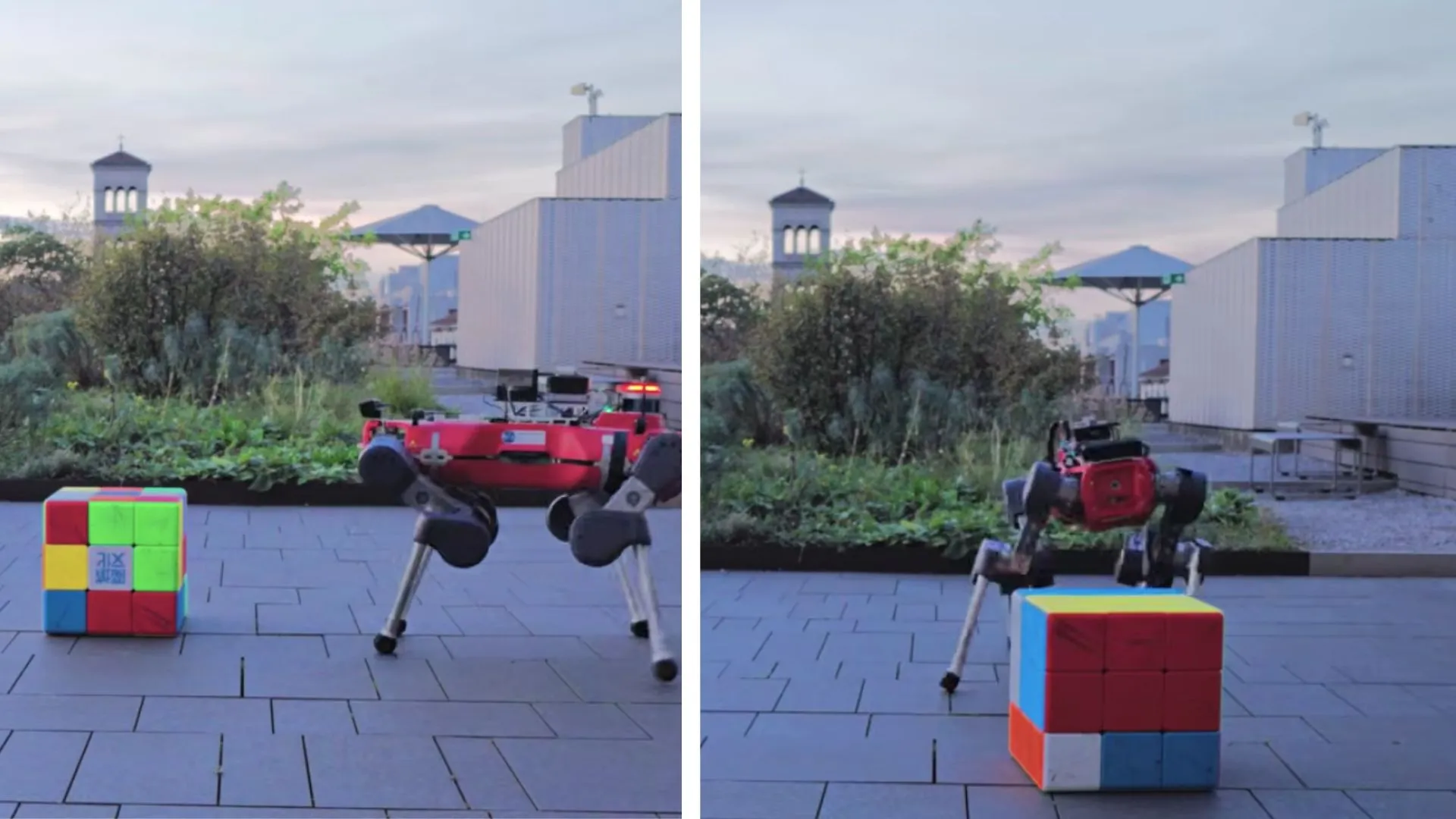
ETH Zurich’s Robotic Systems Lab has showcased its ANYmal-D solving a giant Rubik’s Cube entirely on its own. While not unprecedented for a robot, what makes this feat interesting is that the robot achieved this using its legs while maintaining balance.
Technically called pedipulation (manipulating objects with feet), the team managed this using a combination of classical algorithms, computer vision, and reinforcement learning.
Solving a Rubik’s Cube requires several separate tasks. The first is to understand the starting state of the cube by examining all six faces to see which colors are where.
The next is to plan how to solve it mathematically or, in other words, you need to figure out the sequence of rotations needed. Depending on your knowledge level, this can include executing basic “algorithms” to run through the classic “white cross,” “white corners”, “middle layer,” “yellow cross,” etc or faster methods.
But all stages require physical manipulation of the cube to complete each move. Especially in a way that doesn’t accidentally move the wrong pieces.
For humans, this is usually the easiest part of the process, but for something like a four-legged robot it can be extremely challenging. Since it lacks hands, it needs to move layers and flip the entire cube, all using its legs while maintaining its balance.
To achieve this, ANYmal had to balance on its remaining legs, precisely position its feet, apply the correct forces, and continuously adjust for what happens when it touches the cube. 6 kg).
Source link