
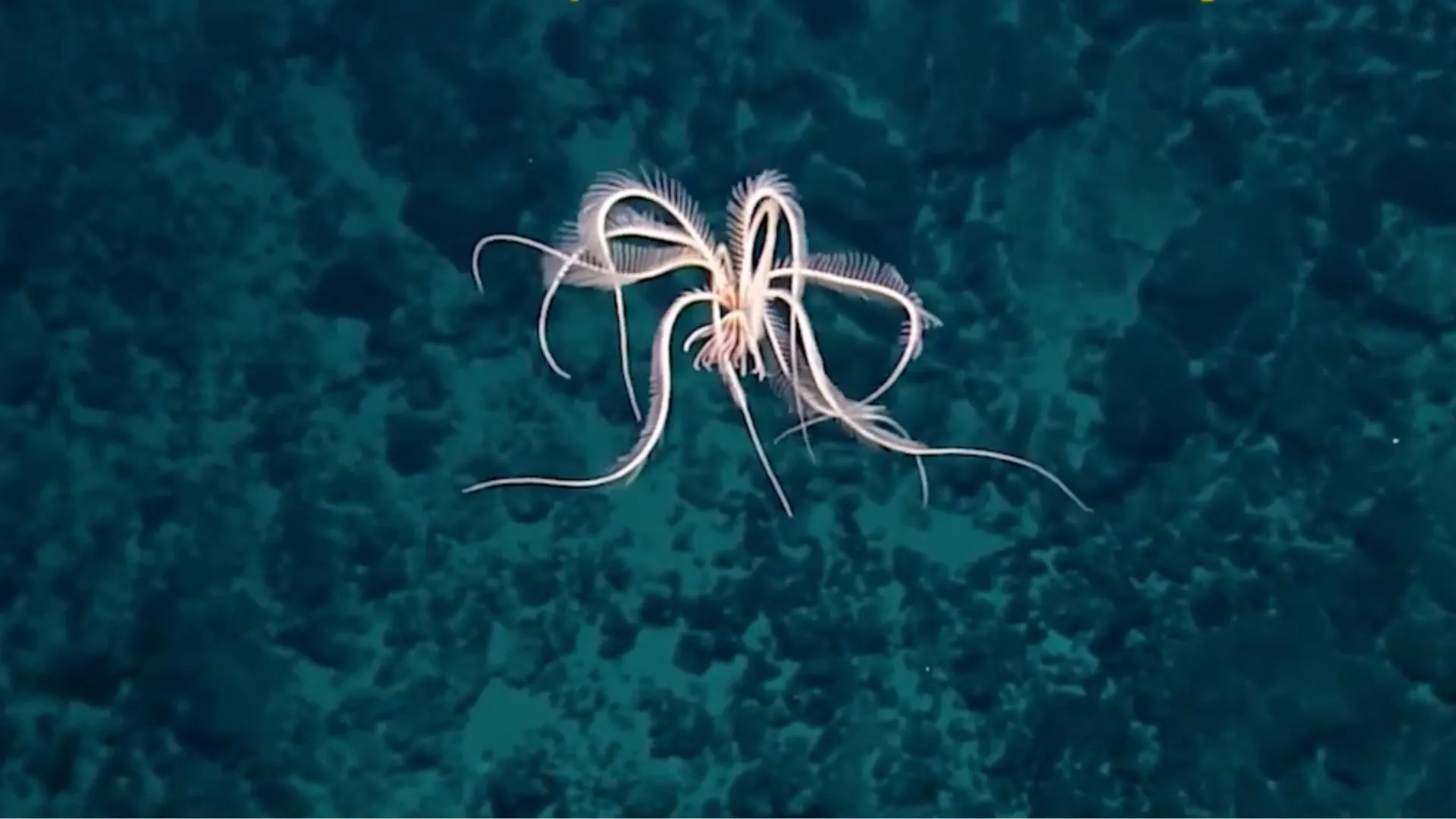
Researchers at North Carolina State University have developed a soft underwater robot inspired by feather stars, a type of marine invertebrate.
The robot can move in three dimensions, including forward and backward, up and down, and rotation around its axis.
It achieves this range of motion using only two actuators, compared with the six typically required for similar three-dimensional movement.
The design uses “mechanical intelligence,” relying on the robot’s structure and interactions with water to reduce the amount of control input needed.
Researchers at North Carolina State University have developed a soft underwater robot that achieves three-dimensional movement using just two actuators, reducing the mechanical complexity normally required for this level of maneuverability.
Inspired by feather stars, marine invertebrates that can move in different directions and hover by coordinating their limbs, the robot uses four elastic wings arranged around a central disk. The wings are monostable, meaning they can bend under actuation but naturally return to their original position when the force is removed. This mechanical design allows the robot to generate several types of motion without requiring a separate actuator for each direction.
According to the NCSU team, the system is based on the principle of “mechanical intelligence,” in which a robot’s physical structure helps determine its behavior and reduces the amount of control input required from computers or human operators. Conventional systems capable of comparable three-dimensional movement would typically require at least six actuators.
“One exciting aspect of this work is that it demonstrates how we can create robotic devices with an incredible range of motion using a minimum number of actuators, by taking advantage of intelligent design techniques,” said Jie Yin, corresponding author of the study and a professor of mechanical and aerospace engineering at NCSU, in a statement .
Source link





