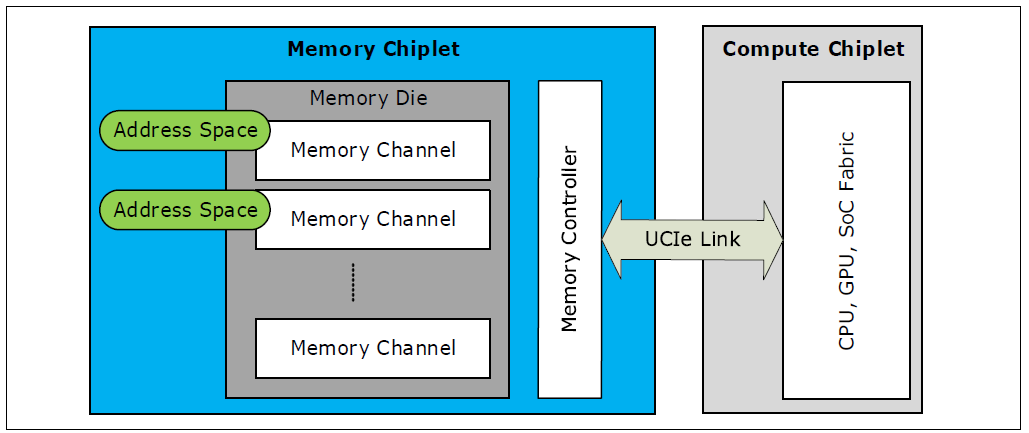
As chiplet-based designs become increasingly common, connecting compute and memory dies efficiently is an important part of building scalable systems. The Universal Chiplet Interconnect Express (UCIe) standard provides a common die-to-die interconnect, while UCIe.mem defines a standardized protocol for memory transactions between compute and memory chiplets.
Modern systems can combine compute chiplets with different memory technologies, including HBM, DDR, and LPDDR. Traditionally, integrating these components can involve technology-specific interfaces and custom mechanisms. UCIe.mem addresses the growing need for scalable and flexible memory architectures in modern computing systems by providing a common, memory-technology-agnostic way to communicate memory requests and responses across chiplets.
This standardization provides a foundation for more modular and scalable chiplet-based architectures. It allows compute and memory chiplets to be developed independently and integrated across implementations from different vendors, reducing reliance on custom, technology-specific interfaces. By decoupling memory communication from the underlying memory technology, UCIe.mem gives system designers greater flexibility to combine, reuse, and scale compute and memory resources to meet different application requirements.
While a common protocol helps streamline integration, verifying UCIe.mem introduces challenges at multiple levels. The protocol must be validated across initialization, credit management, transaction handling, packing, and data integrity. Verification must also account for concurrent requests, different channel configurations, and the correct association of responses with their originating requests.
A further challenge is accommodating different DUT interfaces and levels of integration. mem and may expose only a conventional memory interface, such as AXI. mem and expose FDI, allowing the DUT to generate and receive control and memory payload flits directly.
Source link