Cryptographic code sits at the foundation of modern computing. It protects operating systems, cloud services, firmware, messaging systems, and the protocols that connect them. Small mistakes can have outsized consequences: a single arithmetic slip, missing bounds check, or incorrect state transition can undermine the security of an otherwise sound design.
Testing and auditing remain essential, but they are not enough on their own. Cryptographic implementations are often optimized, constant-time, architecture-specific, and deliberately low level. The code that ships rarely looks like the clean algorithm in a standard: it contains reductions, bit manipulations, SIMD intrinsics, carefully shaped loops, and portability layers for many environments.
Formal verification addresses this gap by deploying machine-checked proofs instead of relying on testing alone. Rather than merely checking that the code usually behaves correctly, verification implements a precise mathematical specification for all inputs that satisfy the stated preconditions.
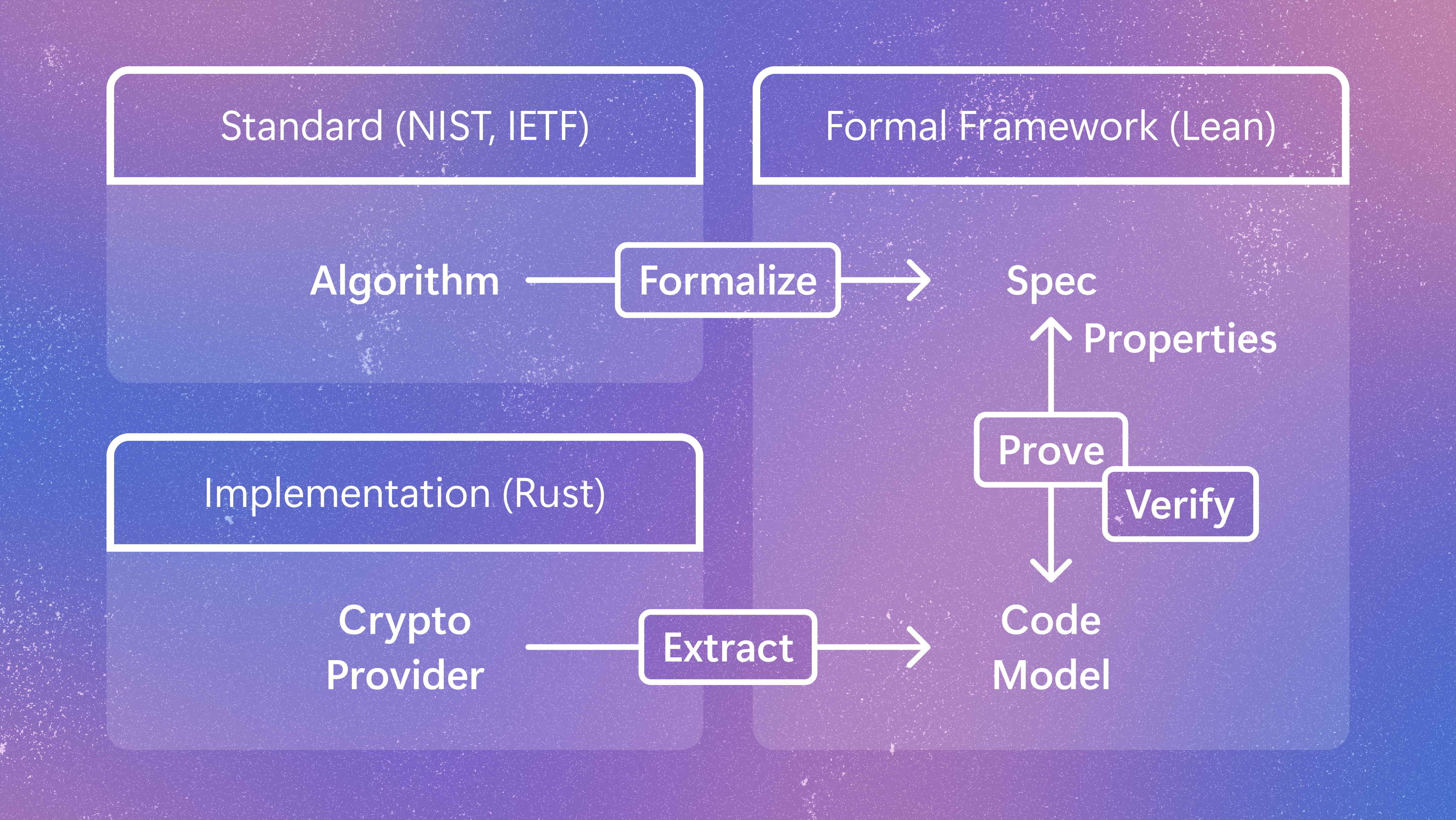
In June last year, Microsoft announced we would formally verify new algorithms written in Rust in SymCrypt, the cryptographic provider used across products and services including Windows and Azure. New cryptographic implementations are being written in safe Rust, then verified in the Lean (opens in new tab) formal proof framework using the Aeneas (opens in new tab) toolchain. This applies in particular to post-quantum cryptography, which require fast secure implementations of complex algorithms. This combination gives us two layers of assurance: Rust rules out broad classes of memory-safety bugs, while Lean proofs establish functional correctness against formal specifications derived from standards.
The result is a new verification methodology for production cryptography: verify code as developers write it, preserve performance-oriented implementation choices, and make the proof process scalable enough to keep up with an evolving codebase.
Source link