Researchers at the University of Pennsylvania have developed artificial muscles that give soft robots more precise control over their movements.
Inspired by small muscles in human hands and eyes, the technology can produce controlled movements, hold intermediate positions, and coordinate with other artificial muscles.
The muscles combine liquid crystal elastomers, graphene, and an embedded copper coil to convert electrical signals into muscle-like motion.
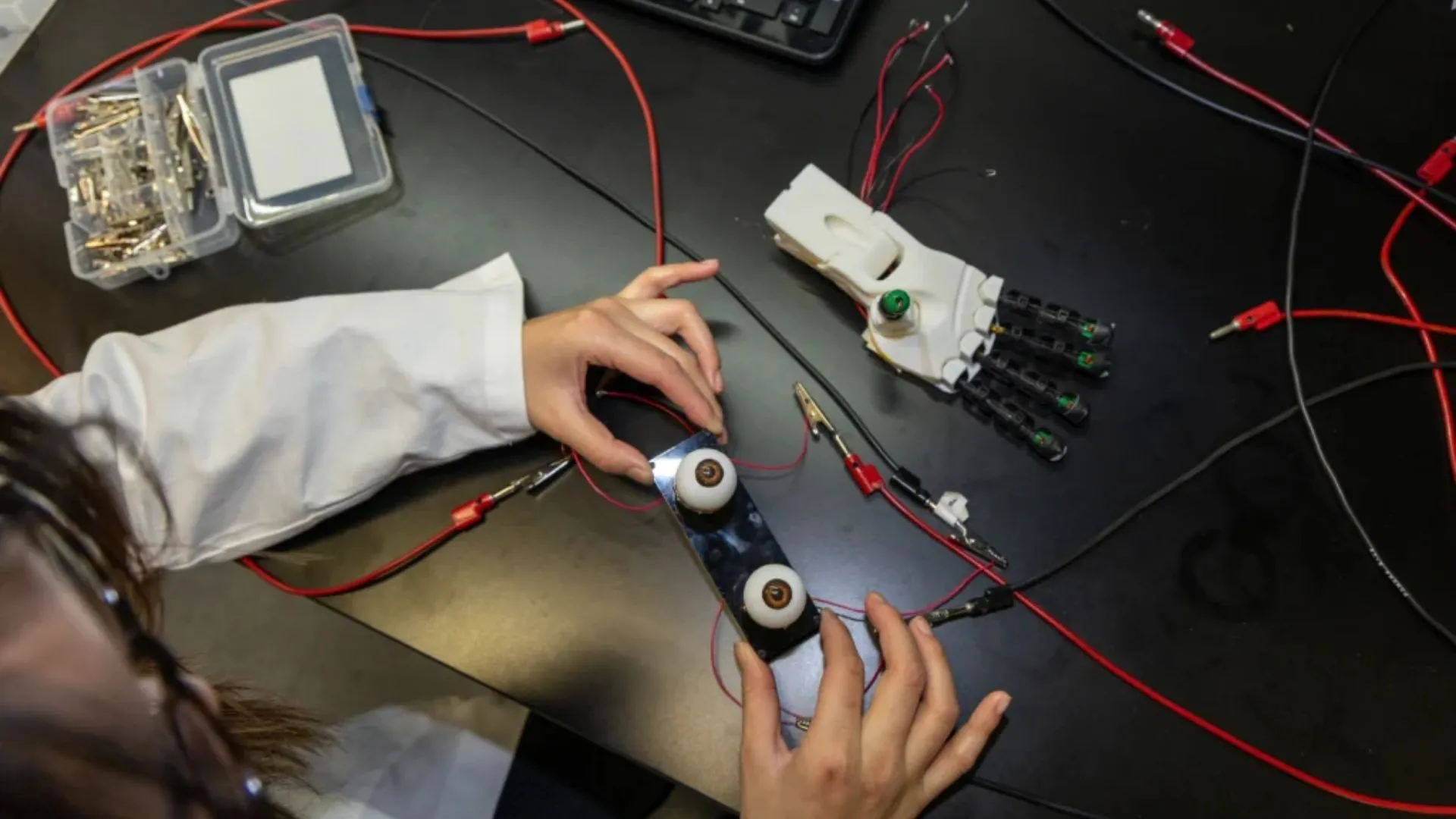
Demonstrations include a robotic finger pressing individual piano keys and artificial eyes shifting their gaze through controlled movements, highlighting the technology’s potential for fine motor skills in soft robotics.
Artificial muscles let soft robots perform precise movements by combining flexible materials with built-in sensing and feedback control.
The technology, called CoilLCE, draws inspiration from the small muscles responsible for delicate movements in human fingers and eyes. It combines liquid crystal elastomers (LCEs), graphene, and an ultrathin embedded copper coil to create artificial muscle fibers that convert electrical signals into controlled mechanical motion.
The team developed the artificial muscles to address a limitation in conventional soft robotic actuators. While traditional robotic motors can provide precise movement, they often require bulky components and complex mechanical arrangements that make it difficult to replicate the flexibility and compactness of biological muscles.
LCEs offer a potential alternative because they change shape when heated. However, controlling their movement presents a challenge. As the material heats up, it contracts, while cooling causes it to return toward its original shape. This makes it difficult to maintain a specific intermediate position without continuous monitoring and adjustment.
Source link