
This article has been reviewed according to Science X's editorial process and policies. Editors have highlighted the following attributes while ensuring the content's credibility:
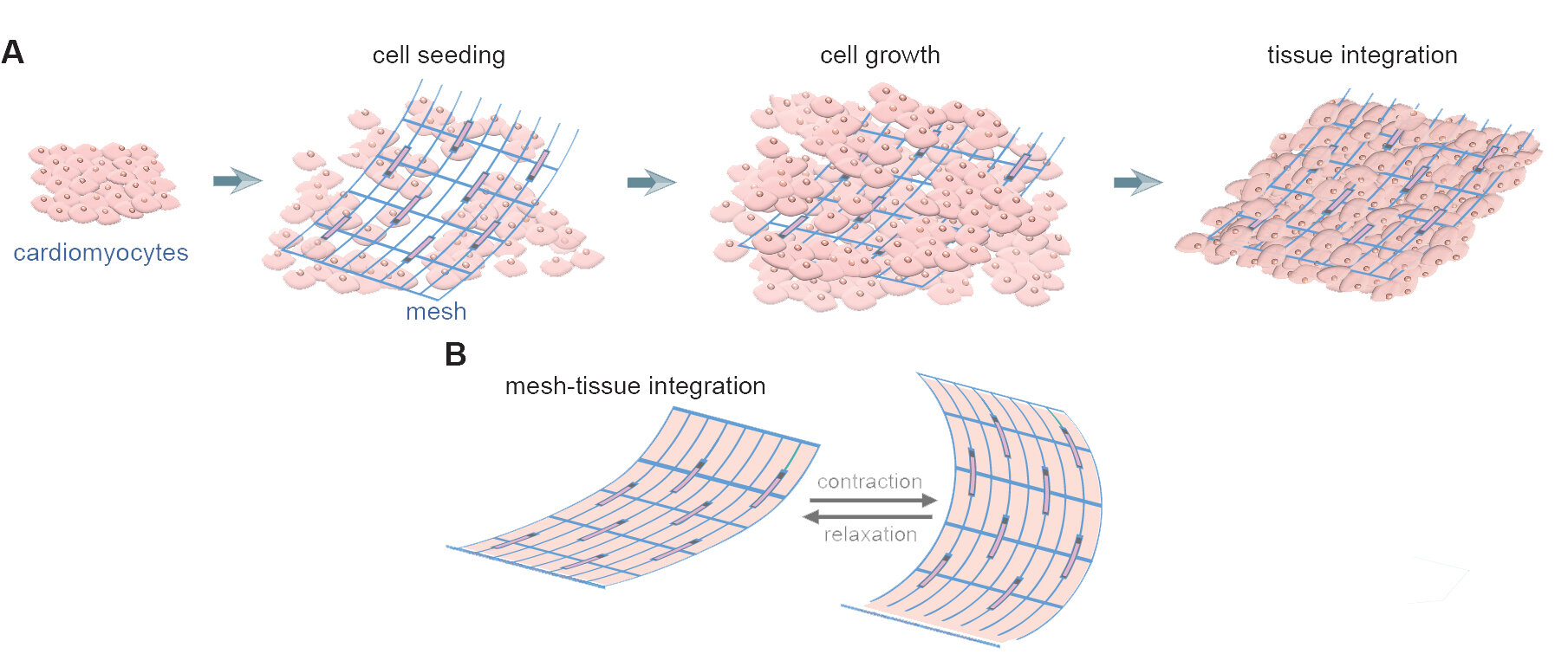
A team of engineers led by the University of Massachusetts Amherst has designed an ultrathin, flexible mesh that seamlessly integrates electronics with human cells to provide a continuous, reliable, powerful electrical supply. The study, published in Science Advances, provides a potential solution to one of the most difficult problems in wearable and implantable electronics: how to get rid of batteries.
"Humans have long dreamed of a future where certain electronics can augment our abilities," says Jun Yao, associate professor in UMass Amherst's Riccio College of Engineering and the paper's senior author. One can think of famous examples from science fiction's cyborgs, but there are also plenty of everyday examples that have nothing to do with Star Trek: pacemakers and implantable defibrillators, for example, or deep brain stimulators, cochlear implants and various health monitors. Every one of these needs a power source.
Unfortunately, batteries—the dominant power source—are bulky and eventually run out of juice, and making them smaller and more flexible reduces the charge they can store.
"But," says lead author Siqi Wang, a Ph.D. student in UMass Amherst's Riccio College of Engineering, "our bodies are 24/7 power plants. Every single cell produces its own power." Some of this power is electrical—think of nerve impulses—and some is mechanical, like the contracting of muscle tissue.
Harvesting that cellular power requires a paradigm shift in electrical engineering—a shift that Yao, who has previously demonstrated a mesh that can grow with and monitor heart tissue , built an artificial neuron that can communicate directly with human cells and discovered how to harvest clean energy from thin air , is leading.
Source link





