This article has been reviewed according to Science X's editorial process and policies. Editors have highlighted the following attributes while ensuring the content's credibility:
The field of silicon photonics, which uses light rather than electricity to transmit and process data on semiconductor chips, has enabled optical systems to evolve from bulky setups to compact, advanced systems. Typically, however, these silicon-photonics chips are rigid and opaque.
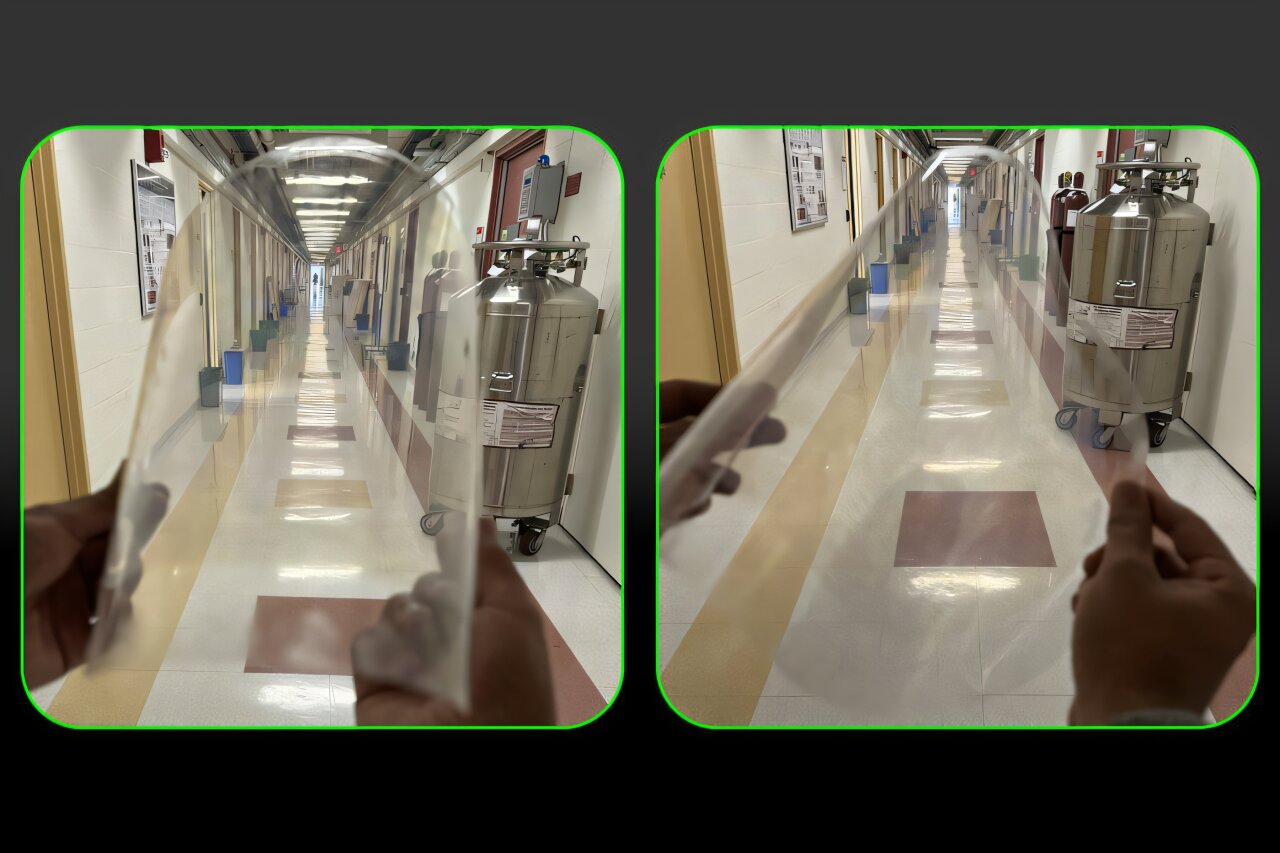
MIT scientists have now figured out a scalable way to make silicon-photonics chips flexible and transparent, opening a route to advanced microchips that could be used in applications such as discrete health monitors that conform to the body or transparent augmented-reality displays that fit the curve of a pilot's helmet.
While scientists have recently performed lab demonstrations of chips that were flexible or transparent, they could only fabricate a few devices at a time.
The MIT researchers, in close collaboration with engineers at NY Creates at the Albany NanoTech Complex, created a fabrication process that uses standard semiconductor manufacturing techniques to generate flexible and transparent silicon-photonics chips on large-scale wafers.
To validate this platform, the researchers bent a single chip thousands of times around cylinders with various diameters—down to the width of a small screw—with no drop in performance. They also determined that looking through the chips would not cause much haze or distortion.
"We've now developed a wafer-scale process that produces wafers that are mechanically flexible and optically transparent, enabling novel applications that weren't previously possible with silicon photonics. We hope that, by working closely with our colleagues at NY Creates and using the foundry at the Albany NanoTech Complex, there's the potential for us to make the platform accessible to other groups within our research community and open these new application areas to the field of silicon photonics as a whole," says Jelena Notaros, the Robert J.
Source link