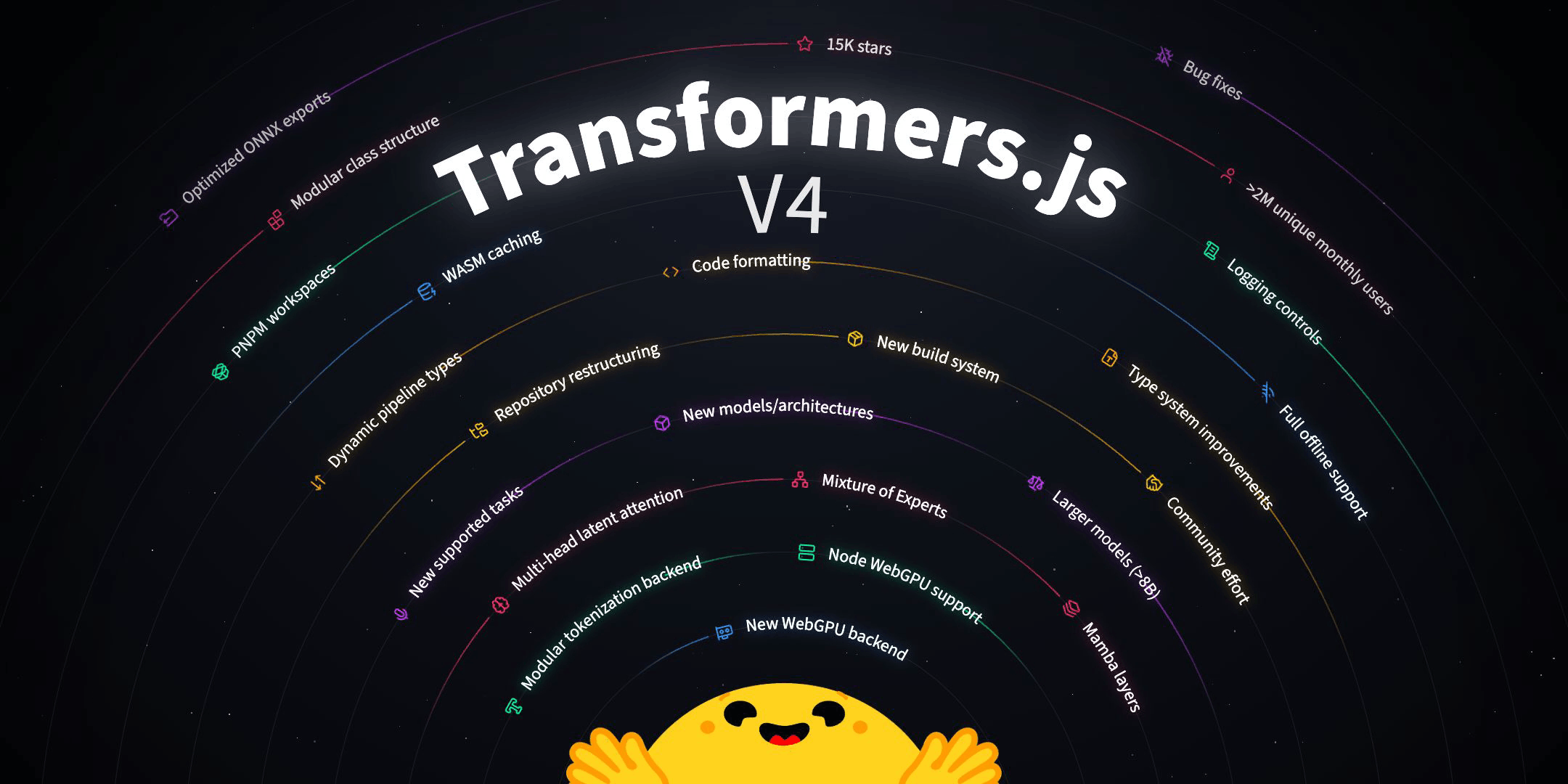
The biggest change is undoubtedly the adoption of a new WebGPU Runtime, completely rewritten in C++. We've worked closely with the ONNX Runtime team to thoroughly test this runtime across our ~200 supported model architectures, as well as many new v4-exclusive architectures.
In addition to better operator support (for performance, accuracy, and coverage), this new WebGPU runtime allows the same transformers.js code to be used across a wide variety of JavaScript environments, including browsers, server-side runtimes, and desktop applications. That's right, you can now run WebGPU-accelerated models directly in Node, Bun, and Deno!
We've proven that it's possible to run state-of-the-art AI models 100% locally in the browser, and now we're focused on performance: making these models run as fast as possible, even in resource-constrained environments. This required completely rethinking our export strategy, especially for large language models. We achieve this by re-implementing new models operation by operation, leveraging specialized ONNX Runtime Contrib Operators like com.microsoft.GroupQueryAttention, com.microsoft.MatMulNBits, or com.microsoft.QMoE to maximize performance.
For example, adopting the com.microsoft.MultiHeadAttention operator, we were able to achieve a ~4x speedup for BERT-based embedding models.
Developing a new major version gave us the opportunity to invest in the codebase and tackle long-overdue refactoring efforts.
Until now, the GitHub repository served as our npm package. This worked well as long as the repository only exposed a single library. js core while addressing different use cases, like library-specific implementations, or smaller utilities that most users don't need but are essential for some.
Source link