This article has been reviewed according to Science X's editorial process and policies. Editors have highlighted the following attributes while ensuring the content's credibility:
AI data centers need to move lots of information quickly, and the demand for faster data transmission is only growing. Over very short distances, data centers can use traditional copper wires to connect chips right next to one another. But over distances longer than 1 m (3.3 feet), the connection requires fiber optic cables.
This is because electrical signals transmitted at fast speeds over copper cables degrade quickly with distance and generate large amounts of heat. In contrast, light signals that travel over fiber optic cables do not degrade and travel quickly without producing heat.
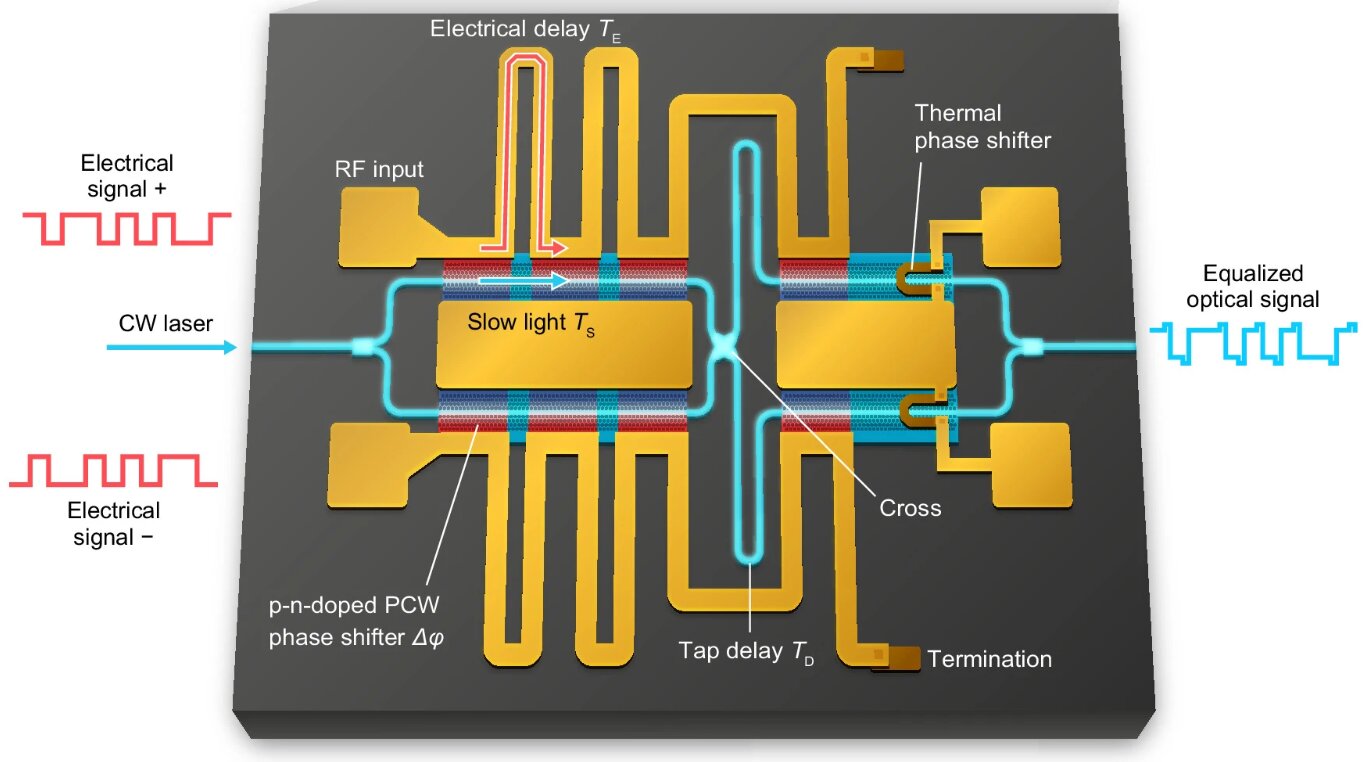
One of the hurdles limiting the speed of data center transmission is the Mach-Zehnder modulator (MZM), a silicon microchip that converts electrical data into light signals. The technology has reached some of its physical limits, and increased transmission speeds will require a modulator that can convert signals more efficiently, ideally with a smaller physical and environmental footprint, reducing energy consumption and heat production.
To address this issue, a group of researchers from Yokohama National University, the Institute of Science Tokyo, the National Institute of Advanced Industrial Science and Technology (AIST) and the Photonics Electronics Technology Research Association (PETRA) developed an engineering technique to generate slowly propagating light, called "slow light," to create a smaller and more efficient silicon modulator.
The team published its paper, "Reduced-DSP 200G/λ low-voltage slow-light silicon modulator enabled by built-in EO equalizer," on Oct.
Source link