This article has been reviewed according to Science X's editorial process and policies. Editors have highlighted the following attributes while ensuring the content's credibility:
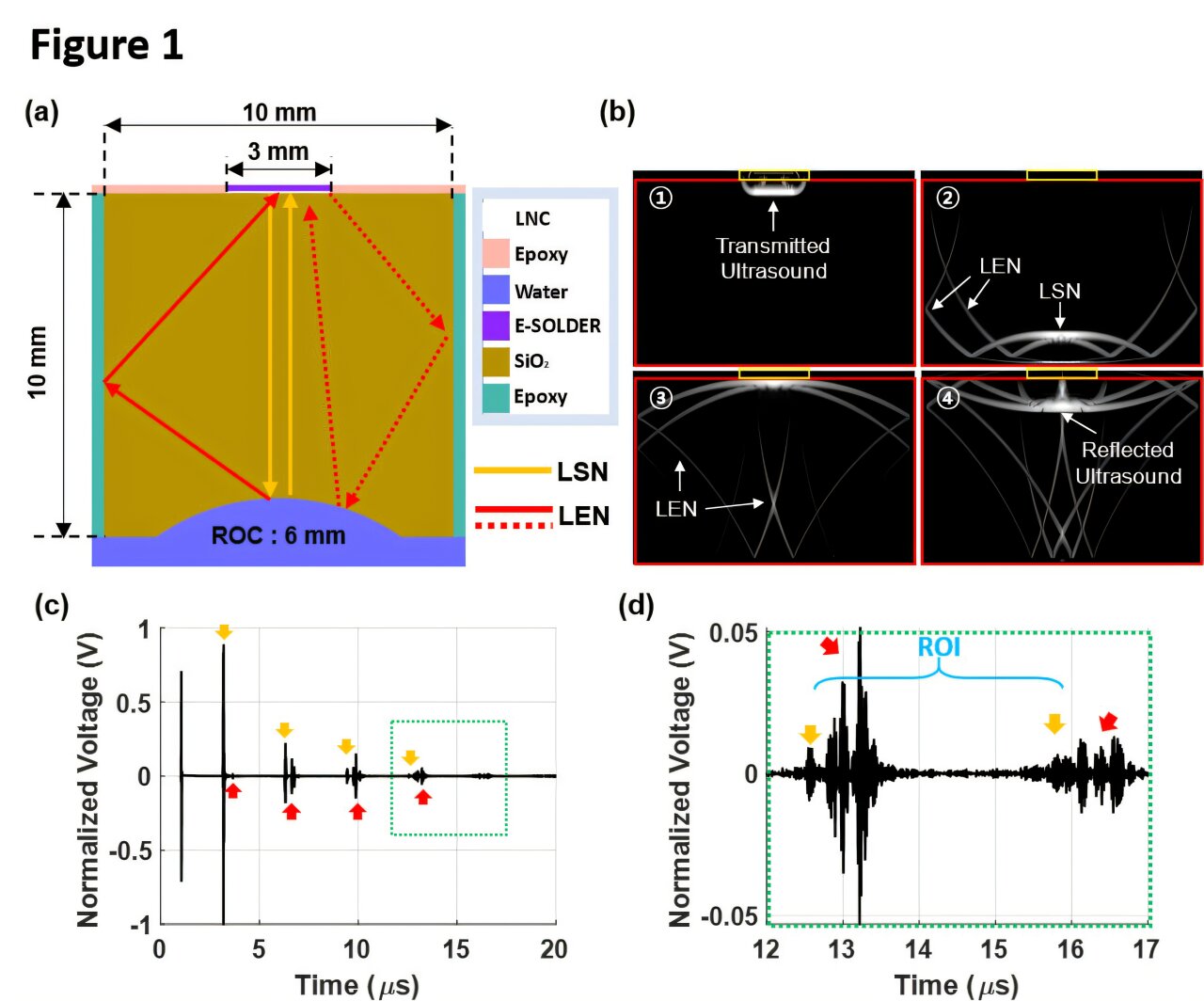
A research team led by professor Chang Jin Ho from the Department of Electrical, Electronic and Computer Science at DGIST has developed an ultrasound transducer with a screw-threaded focusing lens. By etching a threaded structure onto the side of the lens, the team dramatically reduced internal noise, which degrades ultrasound image quality.
This transducer enables clear detection of even ultrafine defects inside semiconductor chips and is expected to help advance quality inspection technologies for high-reliability semiconductors used in electric vehicles and the aerospace industry.
DGIST postdoctoral researcher Kang Sungwoo and integrated master's-Ph.D. student Park Hyunkyu participated as co-first authors in this research, and the paper was published in NDT & E International.
With the recent growth of the electric vehicle and aerospace industries, the reliability of power semiconductors—which must withstand high voltages and heat—has become more critical than ever. Ultrasonic testing offers superior penetration capabilities compared with X-rays or optical inspection, making it a primary method for detecting microscopic cracks or empty spaces (voids) inside semiconductors without damaging the devices.
Semiconductor inspection equipment used at industrial sites primarily employs a method that transmits ultrasonic waves through a water column (the "waterfall" method). However, space constraints limit sensor size. This has resulted in a persistent problem in which irregular "edge noise"—caused by ultrasonic waves reflecting and interfering with each other inside the small lens—significantly reduces image clarity.
Source link