
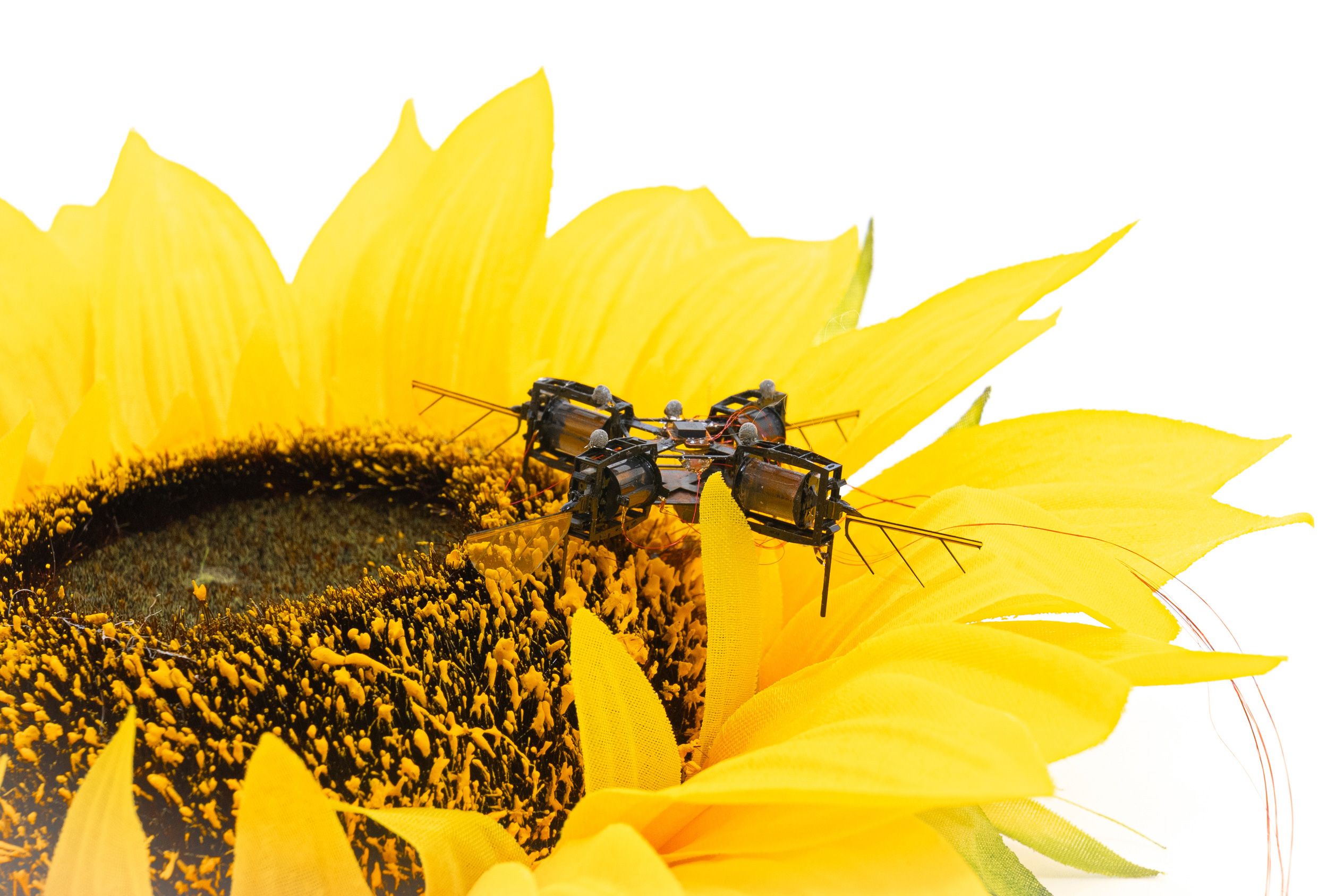
Over the past decade, MIT researchers have developed aerial microrobots with bumblebee-like speed, agility, and durability, for tasks like precision agriculture or search-and-rescue. But these featherweight microrobots couldn’t carry the electronics needed for navigation, forcing them to remain connected to a motion-capture system in the lab.
Now, the researchers have designed a flapping-wing microrobot with onboard sensors and computation, which can follow a complex trajectory and land precisely on a sunflower outside the lab’s motion capture environment.
While the robot is still connected to an offboard power source, this demonstration highlights the potential of aerial microrobots to be used for precision agriculture in the future.
For instance, flying microrobots could weave through a field of almond trees or blueberry bushes to carefully pollinate delicate blossoms in regions where natural pollinator populations have been decimated by habitat loss. They could also hover near plants without causing damage, monitoring crop health and spotting pests before they become widespread.
To enable onboard sensing and computation, the researchers developed a method to expand the artificial muscles that power the robot’s wings, increasing the net payload so the tiny robot could carry the necessary electronics.
They also designed a sensor suite that can rapidly estimate the robot’s position and orientation without relying on an offboard motion capture system, and a miniature electronics package to securely hold the tiny computational components on the nimble vehicle.
“This is a really important milestone for the research community. This is the first demonstration of an aerial microrobot that is sensory and compute autonomous.
Source link





