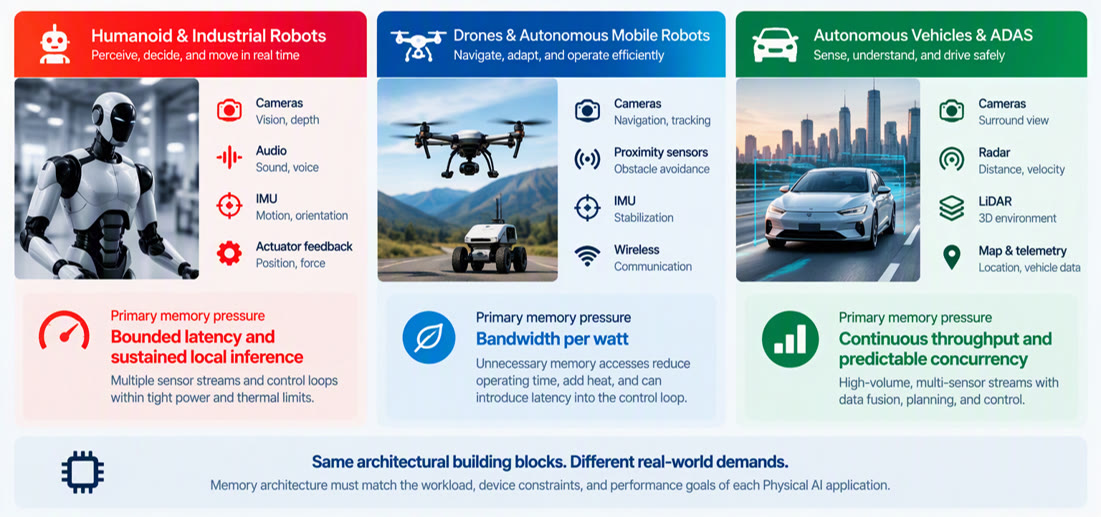
Most AI hardware conversations start with compute, which is understandable since accelerators are visible, easy to compare, and often tied to headline performance metrics. Physical AI broadens that conversation by placing greater emphasis on how compute, memory, and data movement work together under real-world operating constraints. For intelligent systems that must see, interpret, decide, and act in the physical world in real time, it’s critical that the right data reaches the right engine at the right time.
As a result, data movement has become an increasingly important consideration when architecting physical AI systems. A physical AI device may simultaneously handle sensor streams, model weights, activations, temporary buffers, control loops, and safety functions. If memory access becomes unpredictable, compute engines can stall. Power consumption rises when data is moved too often, and poorly planned buffering can cause latency accumulation that is hard to recover from later.
As physical AI workloads become more complex, architects must now consider how predictably the complete system performs when multiple real-world workloads are active simultaneously.
Physical AI systems rely on a memory hierarchy that coordinates on-chip memory with larger-capacity external memory. LPDDR or GDDR may hold model weights, sensor data, activations, and other working data, while on-chip SRAM and cache keep the portions currently needed by the NPU, CPU, DSP, ISP, or other processing engines close to compute.
As workloads move through the processing pipeline, required data is transferred from external memory into on-chip memory, where it can be accessed and reused with lower latency and energy.
Source link