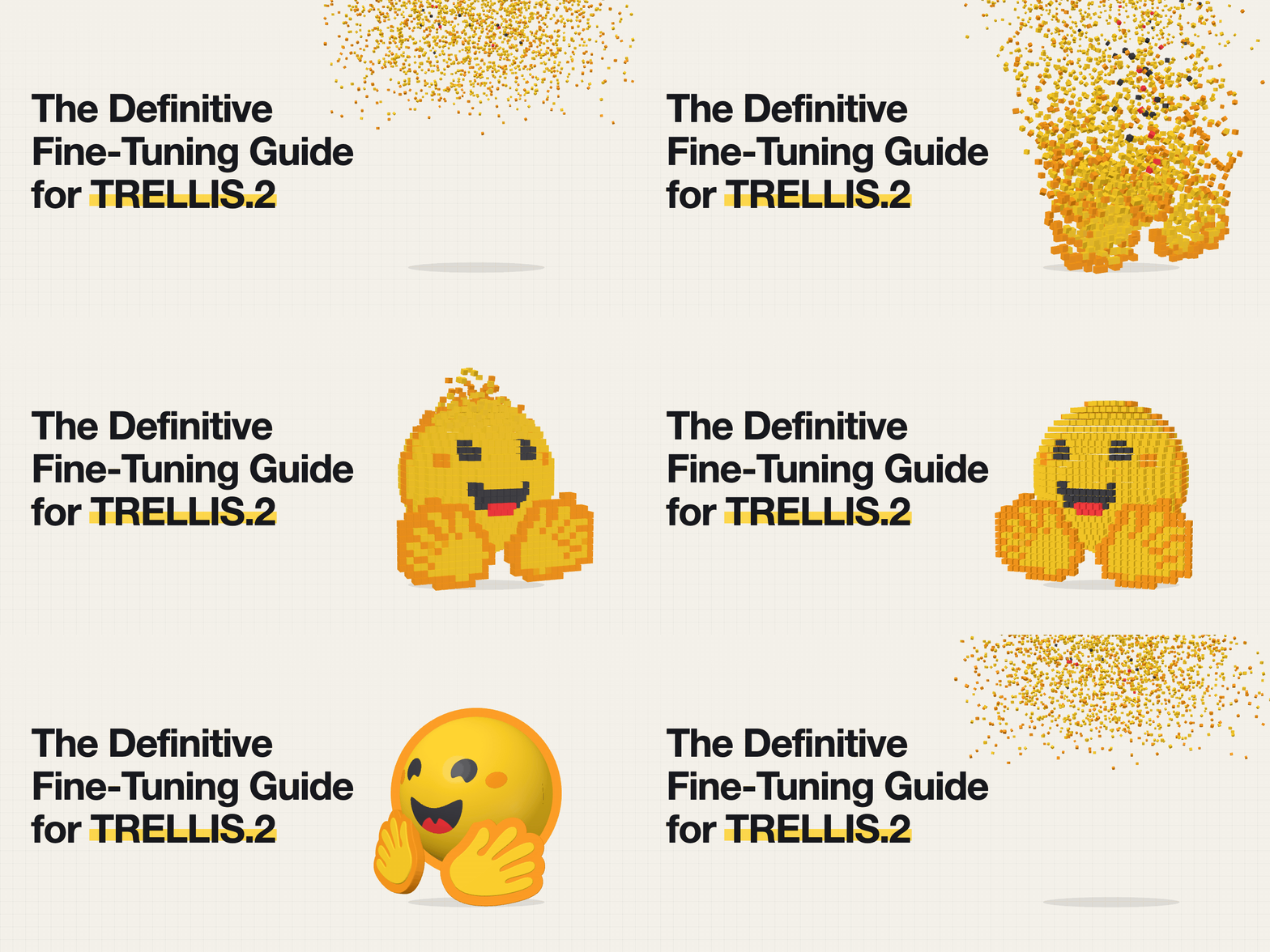
TLDR; In this blog, we provide fine-tuning scripts and containers to fine-tune TRELLIS.2, a popular 3D model on your 3D assets, that can run both locally and on Hugging Face Jobs. If you are interested in fine-tuning, you can use our scripts with few arguments (assuming you updated your dataset to Hugging Face Hub) or tinker with them yourself with this repository. If you want to learn more, we go through how the script works. Let’s go!
3D generation has many uses in robotics, simulation, media, and entertainment. In these fields, it is difficult to make generated objects obey strict rules and standardize model and data representations. There are many file formats, such as GLB and PLY. There are also many representations, such as neural radiance fields (NeRFs) and 3D Gaussian splatting (3DGS). Each one has different advantages and disadvantages.
TRELLIS introduced a common internal representation, called a unified latent representation. Its decoders convert this representation into 3D models in the required output format. Thus, you do not have to use different models for each representation format.
The same team then released TRELLIS.2, which improves the model's representation of 3D structure. But neither model gives an easy way to adapt it to a specific task.
2, can make errors in details that are important for a specific application. For example, a user may need accurate geometry for furniture models. Without fine-tuning for that task, the pretrained model can produce geometry that is insufficiently accurate.
Source link