Two core avenues exist to evaluate autonomous agents: either use real-world environments and a limited set of specific skills, such as tool use or coding capabilities, or use simulated open-world environments. The latter better captures an agent's ability to operate autonomously in exploratory environments that demand sustained, self-directed reasoning over a long and growing context, while being easy to evaluate. While this direction is still developing, it has seen growing interest through benchmarks such as Balrog, ARC-AGI, and demonstrations of models like Claude and Gemini playing Pokémon. Building on this emerging vein of work, we introduce TextQuests.
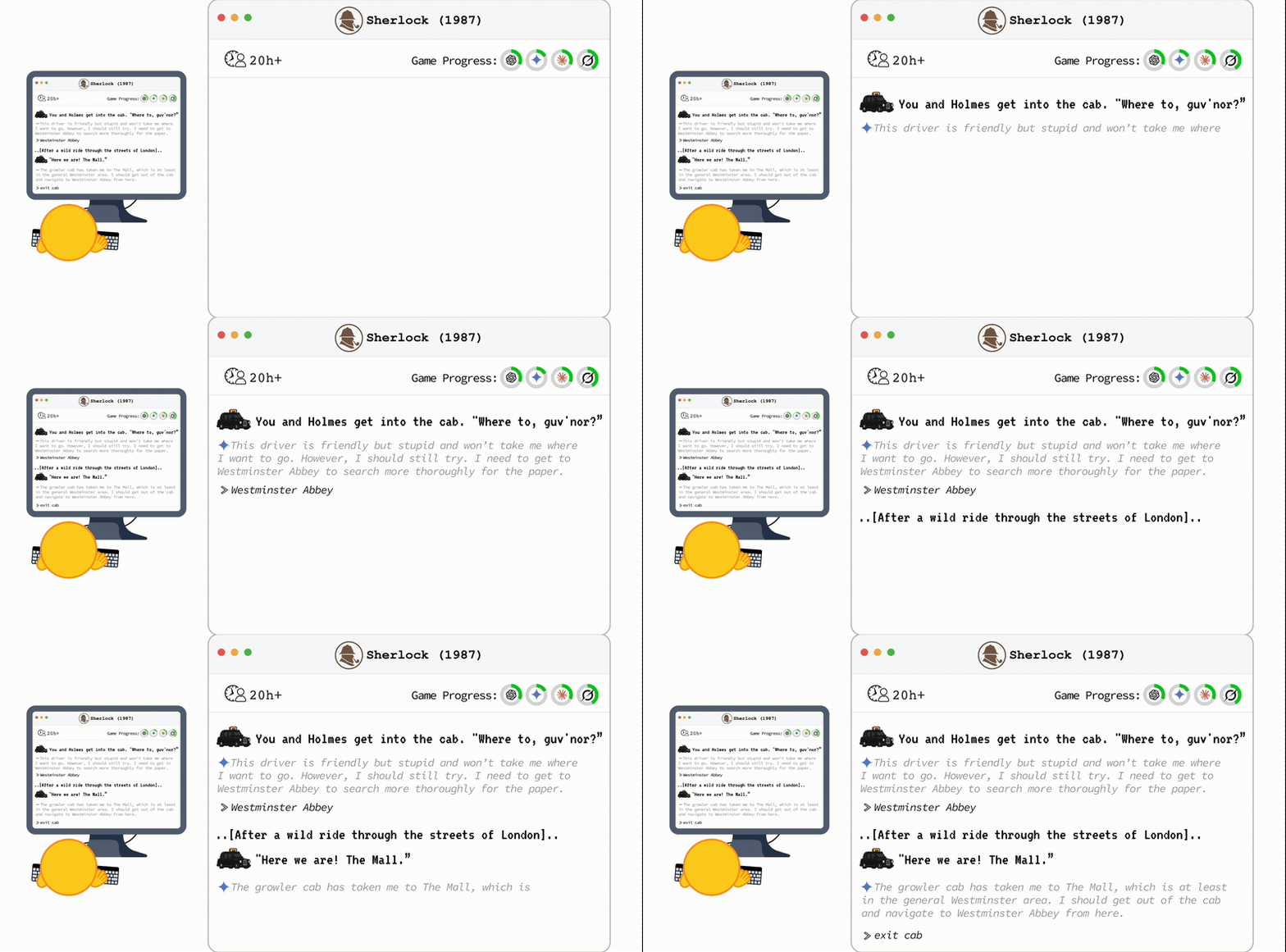
TextQuests is a benchmark built upon 25 classic Infocom interactive fiction games. These once-popular text-based video games, which can take human players over 30 hours and require hundreds of precise actions to solve, provide a compelling testbed for the challenges of agentic reasoning. They demand that an agent demonstrate:
Long-Context Reasoning: Agents must devise and execute multi-step plans by reasoning over a long and continuously growing history of actions and observations, relying solely on their intrinsic capabilities without the aid of external tools.
Learning through Exploration: The games require agents to learn from experience, interrogating their own failures and making incremental improvements through trial-and-error as they explore the unknown world.
Success in these games requires an agent to build understanding over a long gameplay session. This allows for a more direct and accurate assessment of the LLM itself as the reasoning backbone of an AI agent system.
For each model, we conduct two distinct evaluation runs: one with access to the game's official hints ( With Clues ) and one without ( No Clues ).
Source link