This article has been reviewed according to Science X's editorial process and policies. Editors have highlighted the following attributes while ensuring the content's credibility:
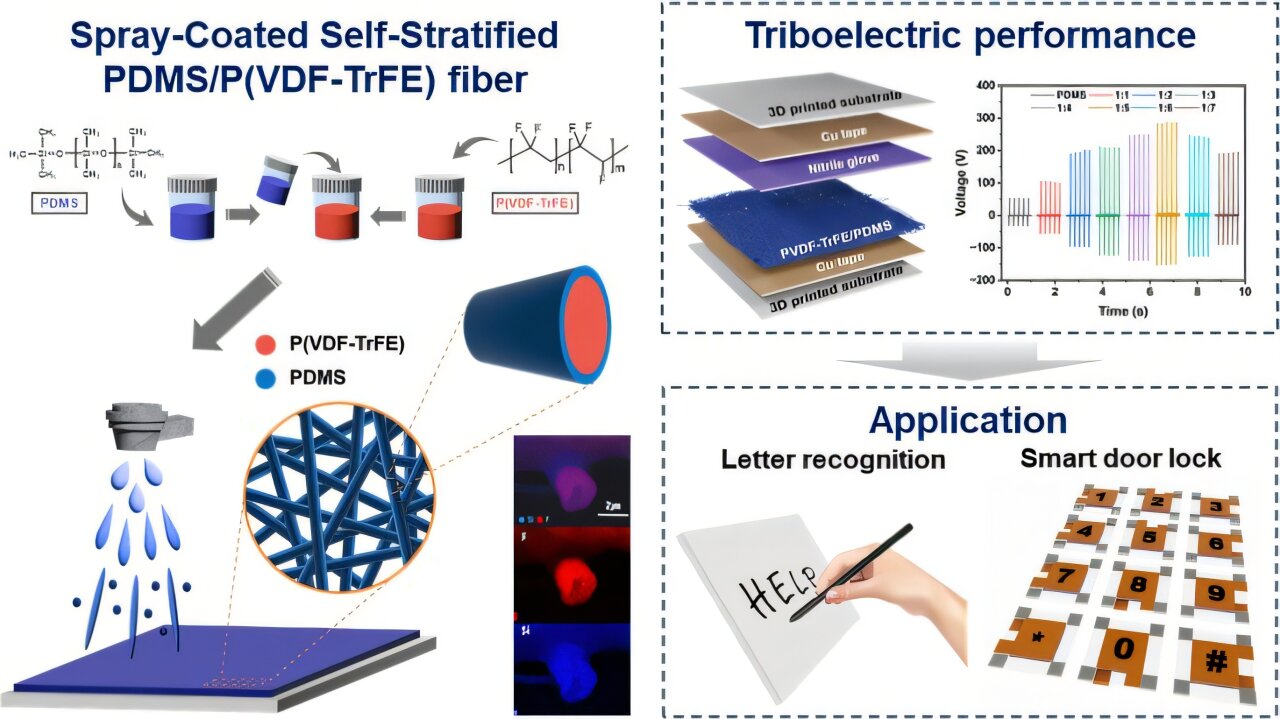
A joint research team has developed self-powered fibers using a simple spray-coating process that blends two different polymers, eliminating the need for high-voltage equipment. The paper is published in the journal Advanced Composites and Hybrid Materials. The technology is expected to simplify complex conventional fiber fabrication processes and facilitate the manufacturing of smart sensors and wearable electronic devices based on triboelectricity.
When two different materials come into contact and then separate, small electrical charges are generated, similar to static electricity. A triboelectric nanogenerator (TENG) converts this phenomenon into electrical energy. Improving the output of a TENG requires both an enlarged effective contact area between the two materials and effective suppression of charge leakage.
One approach is to form the triboelectric material into very fine polymer fibers. Conventional methods, however, have generally required high-voltage equipment to produce the fibers, followed by additional coating processes to suppress charge dissipation. These complicated manufacturing steps also pose challenges for large-area fabrication.
The research team developed a one-step spray-coating process by blending poly(vinylidene fluoride-co-trifluoroethylene), P(VDF-TrFE), a fluorinated polymer with strong electron-withdrawing characteristics, with polydimethylsiloxane (PDMS), a silicone-based polymer with charge-trapping capability. The paper describes P(VDF-TrFE) as a tribo-negative material with high electronegativity and PDMS as a material capable of retaining charges through deep physical and chemical traps.
A higher proportion of the polar β-phase in P(VDF-TrFE) is favorable for enhancing triboelectric performance because it promotes dipole alignment and charge generation.
Source link