
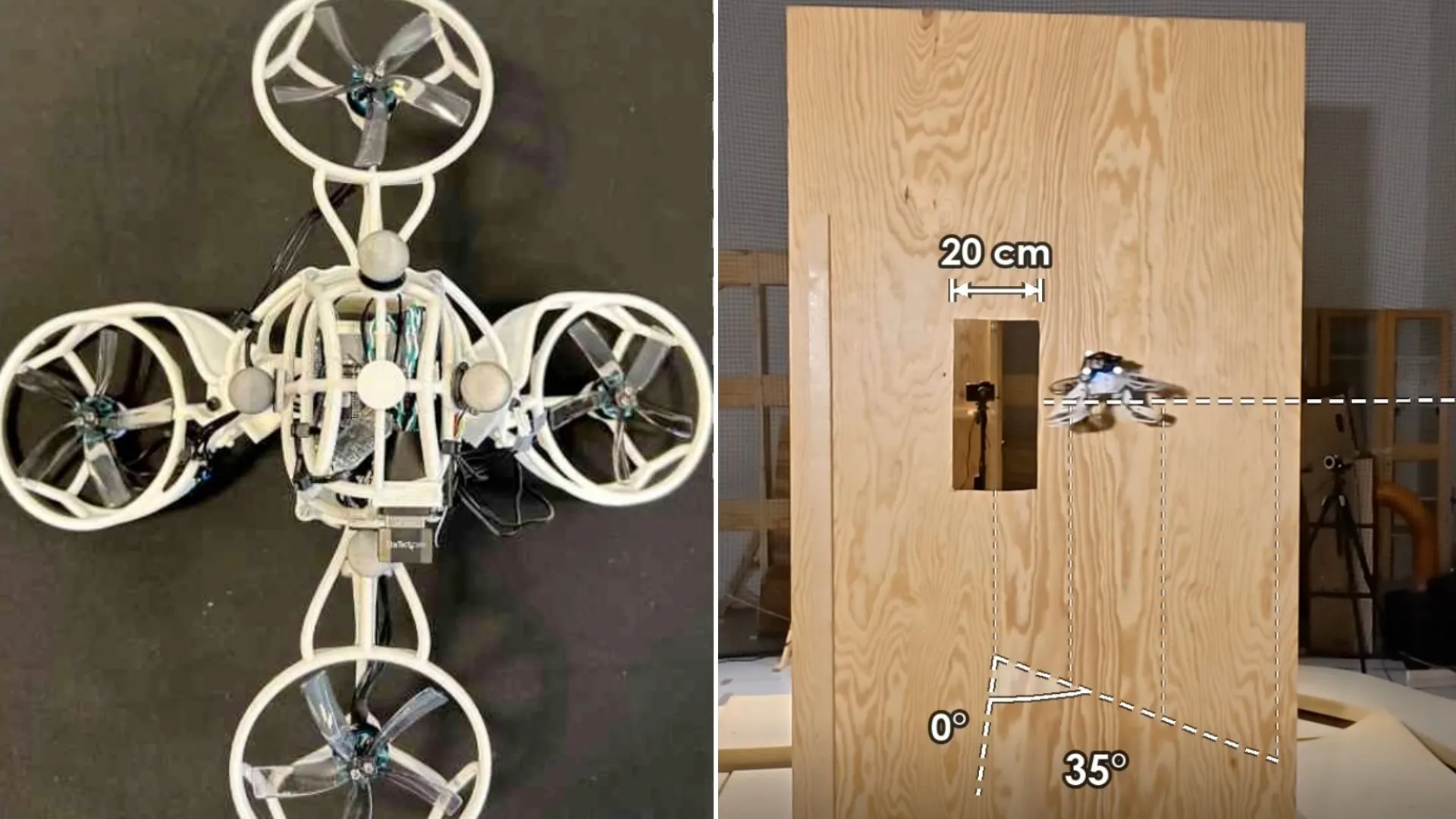
Navigating collapsed buildings, dense industrial piping, or narrow ventilation shafts usually forces small drones to make a painful trade-off. Rigid frames depend on precision sensors and slow maneuvers to avoid fatal collisions, while motorized folding arms add batteries, servos, and wiring that slash flight time.
Researchers at the Autonomous Robots Lab at the Norwegian University of Science and Technology (NTNU), collaborating with ETH Zurich, have built a quadrotor that solves this without a single folding actuator. Using two passive, spring-loaded soft arms, the prototype folds inward on physical contact, shrinking its width by more than half before snapping back open in mid-air.
In a preprint study published on arXiv and demonstrated in a lab video, the team replaced standard rigid side booms with two compliant arms arranged in a plus configuration. Each side arm pivots on an elastic rolling cam joint, a single-degree-of-freedom mechanism made of two spring-loaded cams with interlocking teeth that roll against each other without slipping. By shaping the profile of those cams, engineers can program the exact torque-to-angle stiffness response of the arm.
Rather than guessing how stiff or long those arms should be, the researchers fed a 22-parameter airframe geometry and joint-stiffness model into a closed-loop optimizer. In simulation, a nonlinear model predictive controller flew each candidate design through gaps ranging from 5.9 to 9.8 inches (15 to 25 centimeters), using successful traversal rates to iteratively refine the physical layout.
Optimizing both arm geometry and joint compliance together proved essential, enabling the drone to clear openings 52 percent narrower than its nominal span, compared to roughly 29 percent for earlier contact-folding quadrotors.
Source link





