Researchers at Sandia National Laboratories and Luxembourg Institute of Science and Technology published a technical paper titled “Revealing New Leakage Paths in GAAFETs using Predictive First-Principles Simulations.”
“Gate-All-Around Field-Effect Transistors (GAAFETs) are emerging as successors to Fin Field-Effect Transistors (FinFETs) and are central to continued scaling at advanced semiconductor nodes. Despite their improved electrostatic control, recent measurements show that the drain current in GAAFETs deviates strongly from thermionic behavior at negative gate voltages, increasing as the gate voltage becomes more negative. This leakage has been attributed to direct gate-drain tunneling through the high-k dielectric, enhanced by drain-induced dielectric barrier lowering (DIDBL). Here, we use predictive, charge-self-consistent Non-Equilibrium Green Function (NEGF) simulations based on the Contact Block Reduction (CBR) method to spatially resolve this leakage pathway in GAAFETs.”
Mamaluy, Denis, Juan P. Mendez, Coleman Cariker, Michael Titze, and Alex A. Belianinov. “Revealing New Leakage Paths in GAAFETs using Predictive First-Principles Simulations.” arXiv preprint arXiv:2610.14298 (October 2026). https://doi.org/10.48550/arXiv.2610.14298. Creative Commons license.
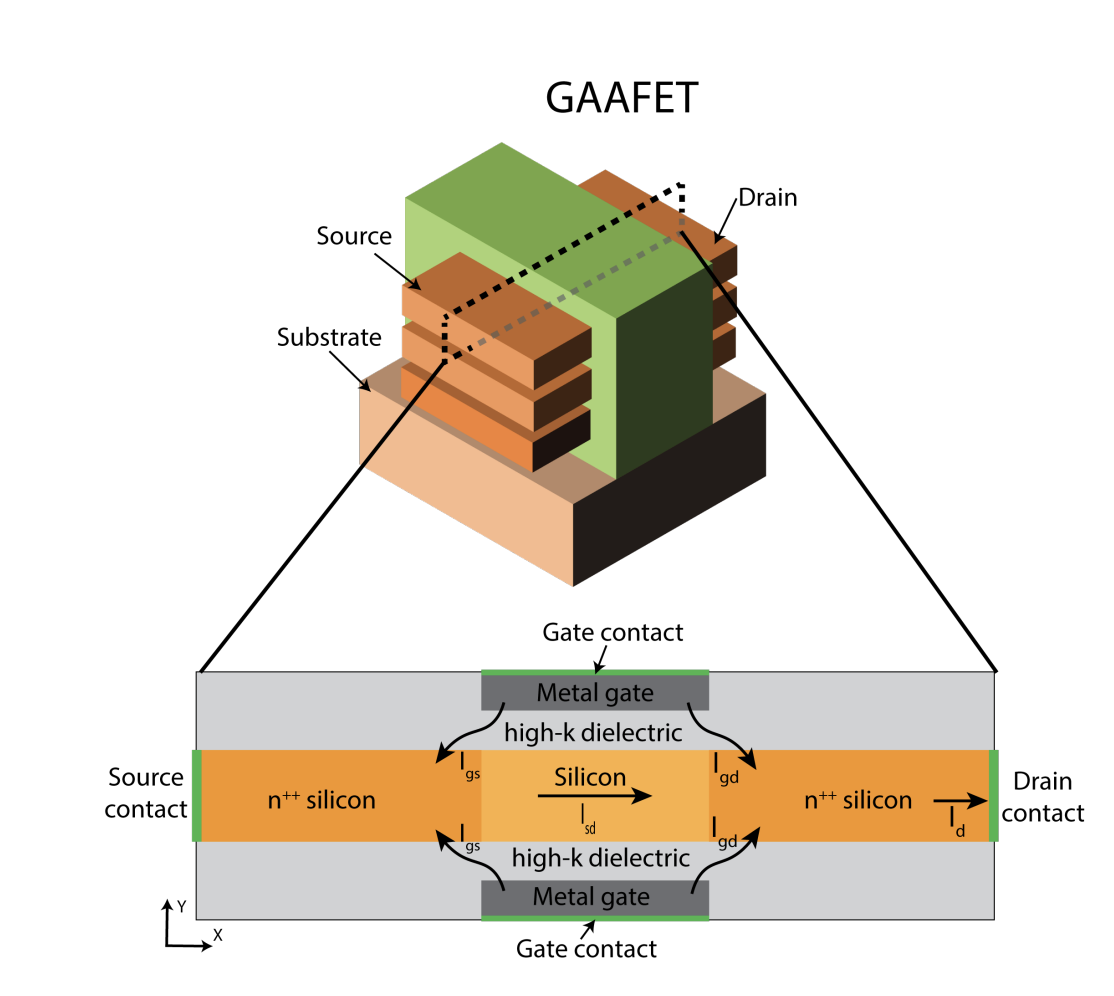
Fig.1: GAAFET architecture and cross-sectional schematic of the single-sheet GAAFET device used in this work. Source: Revealing New Leakage Paths in GAAFETs using Predictive First-Principles Simulations
Source link