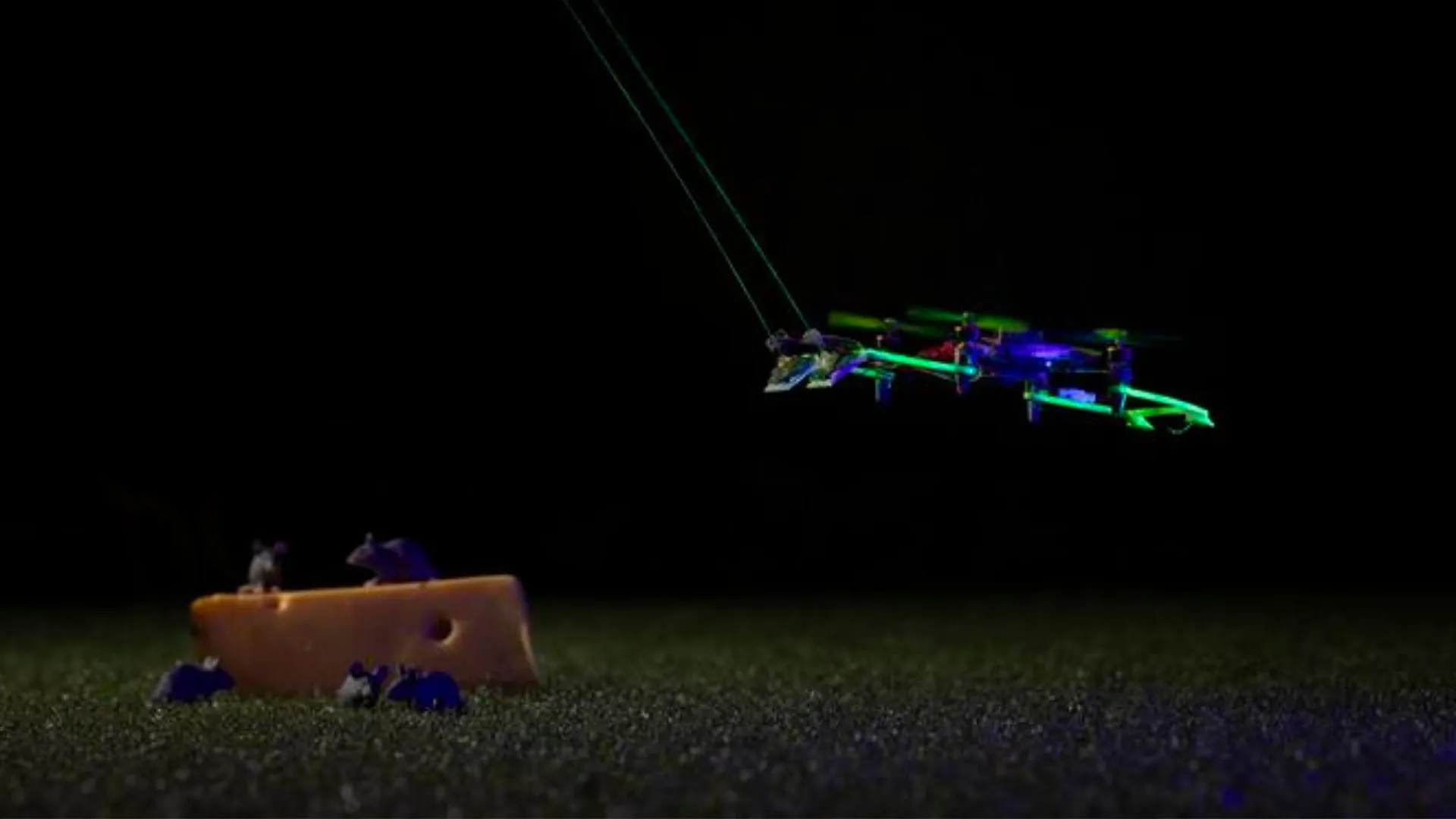
A new technology has solved one of robotics’ biggest issues: how to make tiny, ultralight drones navigate when they are essentially flying blind.
Taking a direct cue from rodents scurrying through dark underground burrows, researchers developed a whisker-based tactile framework that lets drones feel their way through complex spaces.
A pair of rodent-inspired artificial whiskers mounted at the front of a tiny drone provides real-time feedback as it touches its surroundings. This compact setup brings touch-based navigation directly to lightweight flying robots, replacing older systems with robotic arms or bumpers.
“Here, we aim to equip drones with rich tactile sensing—not for manipulation in the air, but for a novel concept of tactile navigation: using touch to explore and fly through the unknown. Inspired by nature, we found the answer in whiskers,” explained Salua Hamaza, Associate Professor of Aerial Physical Interaction & Embodied Intelligence in Aerial Robots at Delft University of Technology, The Netherlands.
Rats and mice rely on their whiskers (or vibrissae) as a high-precision tactile navigation system that replaces sight in the dark. Each whisker is packed with sensitive nerve endings at its base that detect tiny deflections, vibrations, and pressure changes when brushing against surfaces.
Rodents can measure tight spaces, feel nearby walls, and map out their surroundings by quickly wiggling their whiskers. This lets them dash through cramped, pitch-black areas without bumping into things.
Inspired by this natural technique, the development tackles a fundamental challenge in aerial robotics. Flying robots weighing under 100 grams simply cannot carry heavy LiDAR systems or energy-hungry processors.
Source link