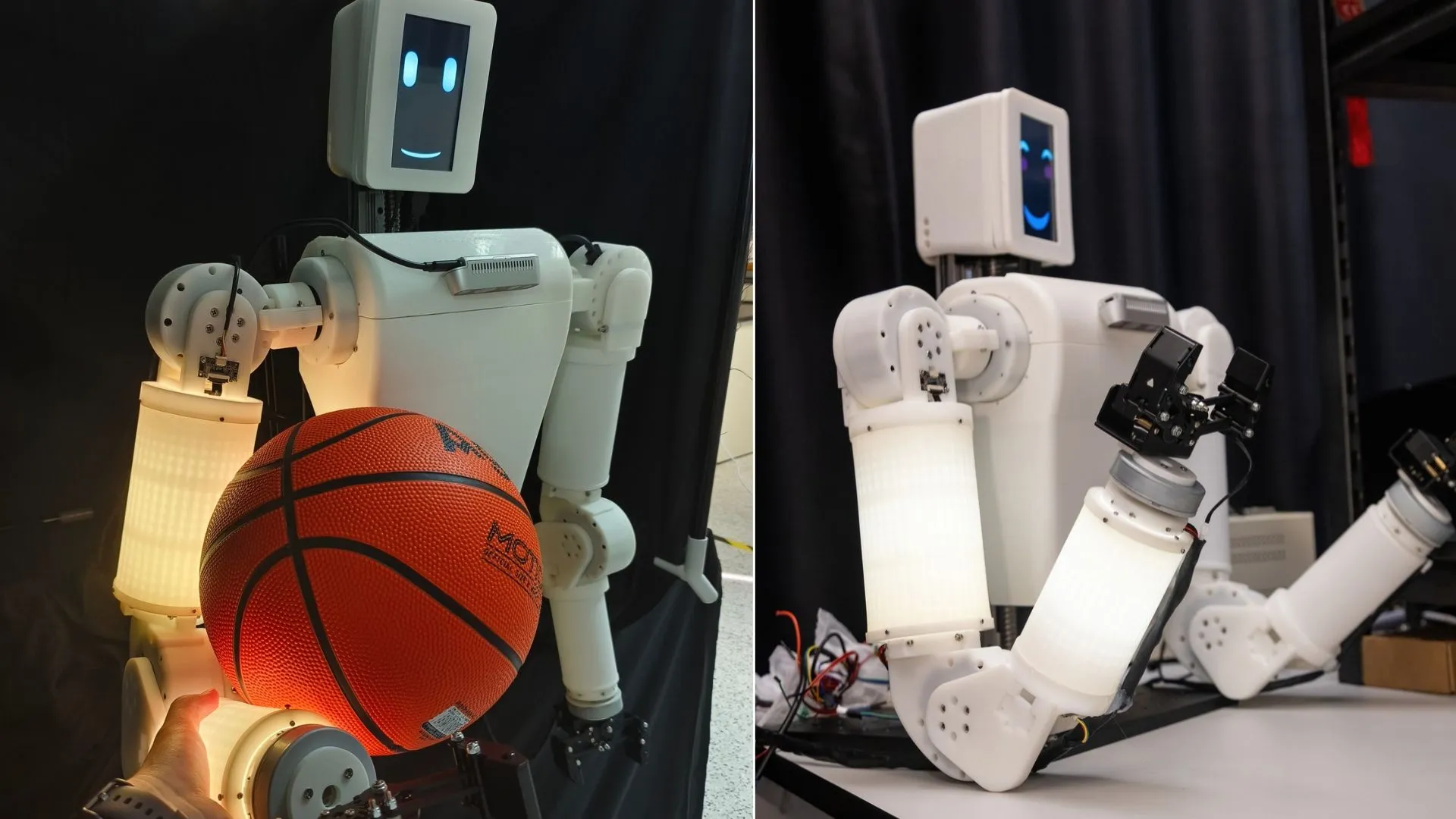
Researchers at The Hong Kong University of Science and Technology (HKUST) have developed a robotic arm that replicates aspects of human touch perception.
EmArm integrates a soft optical tactile skin into its rigid mechanical structure, allowing it to detect contact across its upper and lower arms.
By combining tactile feedback with information about its own movements, EmArm can adjust its posture, manipulate objects, and avoid obstacles in real time.
The system can also distinguish between different types of touch, including tickling and patting, supporting research into adaptive manipulation for embodied intelligent robots.
The robotic arm combines whole-arm tactile sensing with high-precision movement control. The system integrates a soft optical skin into its rigid mechanical structure, allowing it to detect contact, measure applied forces, and respond to physical interactions in real time.
The technology helps robots manipulate objects and navigate around obstacles using touch, including when visual information is unavailable or obstructed.
EmArm takes inspiration from the human body’s bone, muscle, and skin structure. Rather than attaching conventional tactile sensors to the outside of a robot, the researchers embedded a large-area soft optical sensing layer within the arm’s rigid mechanical skeleton.
The tactile skin covers more than 71,000 square millimeters across the upper and lower arms. Small cameras measuring less than a millimeter in scale capture changes in the skin caused by contact and analyze the distribution of forces acting on the arm.
This approach allows EmArm to detect physical interactions across a much larger surface than a conventional robotic hand sensor.
Source link