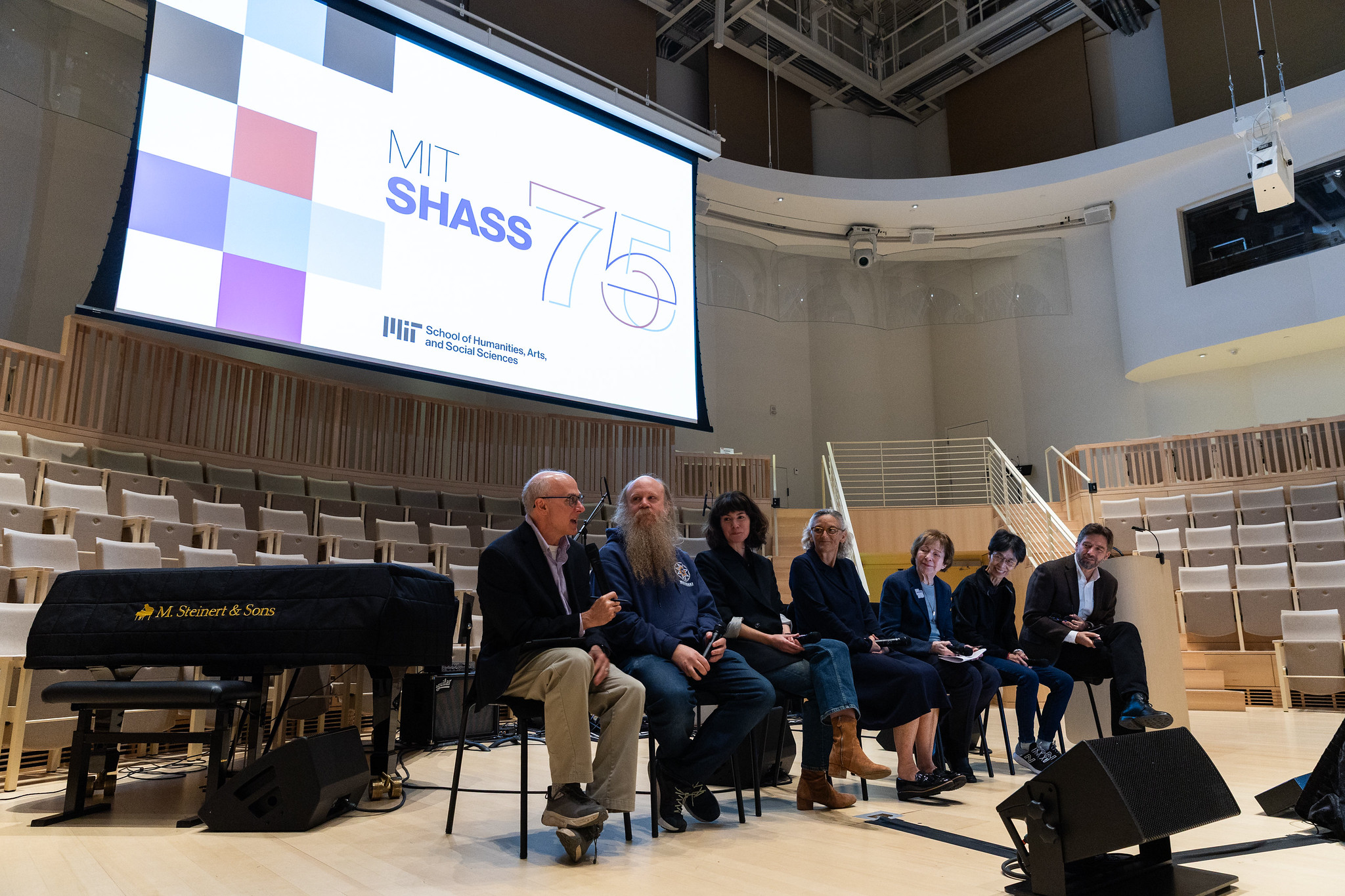
At the MIT School of Humanities, Arts, and Social Sciences (SHASS) 75th Anniversary Symposium, speakers celebrated the school’s value and contributions, while exploring how artificial intelligence is transforming many aspects of teaching, research, and society.
The symposium was held Sept. 24-25 in the Linde Music Building’s Thomas Tull Concert Hall. Scholars, students, staff, and alumni from across SHASS and MIT gathered for the event, which kicked off with welcoming remarks from MIT leadership.
“How should we think about MIT’s School of Humanities, Arts, and Social Sciences? With enthusiastic appreciation and gratitude,” said President Sally Kornbluth.
The school’s origins date back to the Lewis Committee Report, commissioned by MIT and published in 1949, which called for stronger integration between scientific and technical topics and humanistic scholarship and teaching.
Kornbluth noted that, much like when the school was founded just after World War II, the world faces uncertainty as it grapples with the broad implications of artificial intelligence.
“AI has suddenly arrived with enormous consequences for both research and education,” she said. “As we face the challenges of our own time, and our own society, it’s clear that MIT has never needed your particular insight and guidance more than we do now.”
In opening remarks, Provost Anantha Chandrakasan described the importance of a human-centered approach to technology, one that considers both its efficacy and its impacts. He lauded many of the new research projects happening through the MIT Human Insight Collaborative, a strategic initiative launched in 2024.
“Today — a time of rapid, AI-driven change — the arts, humanities, and social sciences are as important as ever,” he said.
Source link