As AI agents become capable of carrying out increasingly complex and autonomous tasks, maintaining reliable oversight of their behavior becomes more important. Consistent with our principle of iterative deployment, we study how systems behave in real-world settings and continuously refine safeguards as capabilities advance. To support this, our safety approach uses defense-in-depth, with multiple complementary layers of defense such as safety training, behavioral testing, agentic code review(opens in a new window), and chain-of-thought (CoT) monitoring. CoT monitoring analyzes the reasoning steps agents generate while pursuing tasks. These reasoning traces can provide valuable signals during both training and deployment, helping monitoring systems identify when an agent’s behavior may be unsafe or inconsistent with the user’s intended goals.
Today, we find that models’ reasoning is generally interpretable and easy to monitor. However, in the future, monitorability may break down for a variety of reasons(opens in a new window). Here, we focus on one such path: if agents become capable of deliberately reshaping or obscuring their reasoning when they know they are being monitored, evaluations could overestimate a system’s alignment or safety, and monitoring systems could become less reliable.
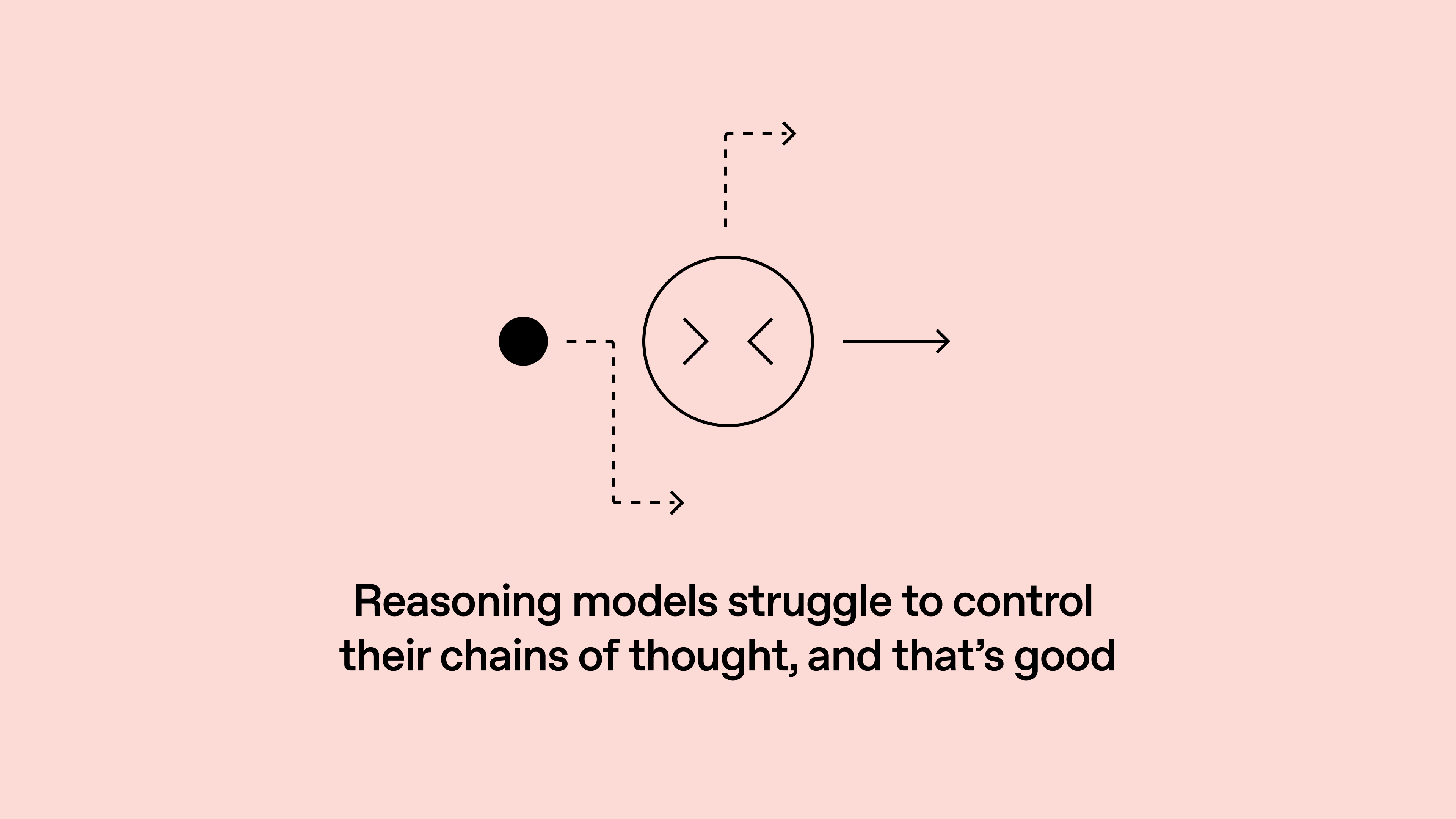
In this work, we study whether current reasoning models are capable of controlling their chain of thought in ways that reduce monitorability. Understanding this capability is important for ensuring that CoT monitoring remains a robust safeguard as AI systems grow more capable. We find that current reasoning models struggle to control their CoTs, even when told they are being monitored.
Source link