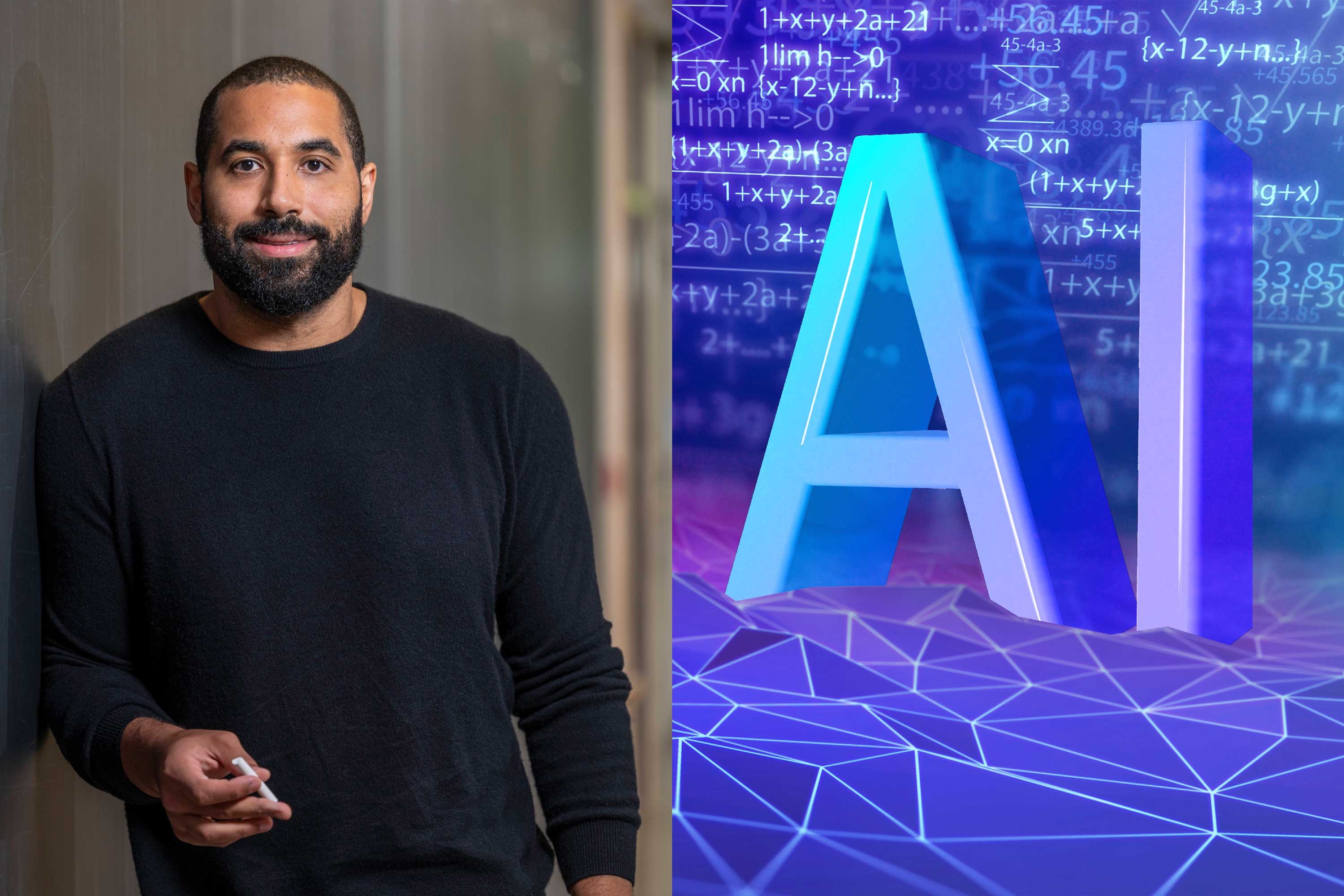
John Urschel PhD ’21, the Class of 1956 Career Development Assistant Professor in the MIT Department of Mathematics, is no stranger to building muscle: Before earning his PhD at MIT, Urschel strengthened his offensive muscles as a lineman for the Baltimore Ravens. He remains committed to helping his students exercise, but now his focus is on critical thinking skills. In the classroom, Urschel shares with his students his lifelong love for solving puzzles, while honing their abilities to be strong qualitive thinkers — skills he argues will be essential in an artificial intelligence-enabled world.
Urschel recently published two preprints on arXiv, one on the growth factor of random matrices, the other on worst-case behavior in Gaussian elimination, in which he used a combination of human insight and AI tools to solve problems that had stumped mathematicians for decades. That experience provided Urschel with new insights into the future of mathematics and higher education, and the enduring importance of the in-person, residential education offered on college campuses, where students can experience the importance of struggle, problem solving, and human connection. Urschel recently chatted with MIT News about education, AI, and mathematics; excerpts from the conversation follow.
Q: What is it about studying math that you hope to share with your students?
A : When I was very little, I loved solving puzzles, whether that’s Sudoku puzzles or Martin Gardner math puzzles or crossword puzzles. I think there’s something really enjoyable about being faced with some problem that you don’t quite understand, trying to get your bearings, trying to make your way through it, and finally gleaning some sort of understanding from it.
Source link