In modern automated manufacturing, six-axis articulated robots perform high-speed, multidirectional maneuvers under demanding operational cycles. However, as robot arms swivel, rotate, and extend, the electrical cables, fiber optics, and pneumatic hoses supplying them endure severe mechanical stress. Torsional twist, rapid acceleration, and repeated contact with machine structures often lead to premature conductor fatigue, insulation breakdown, and costly unplanned production halts.
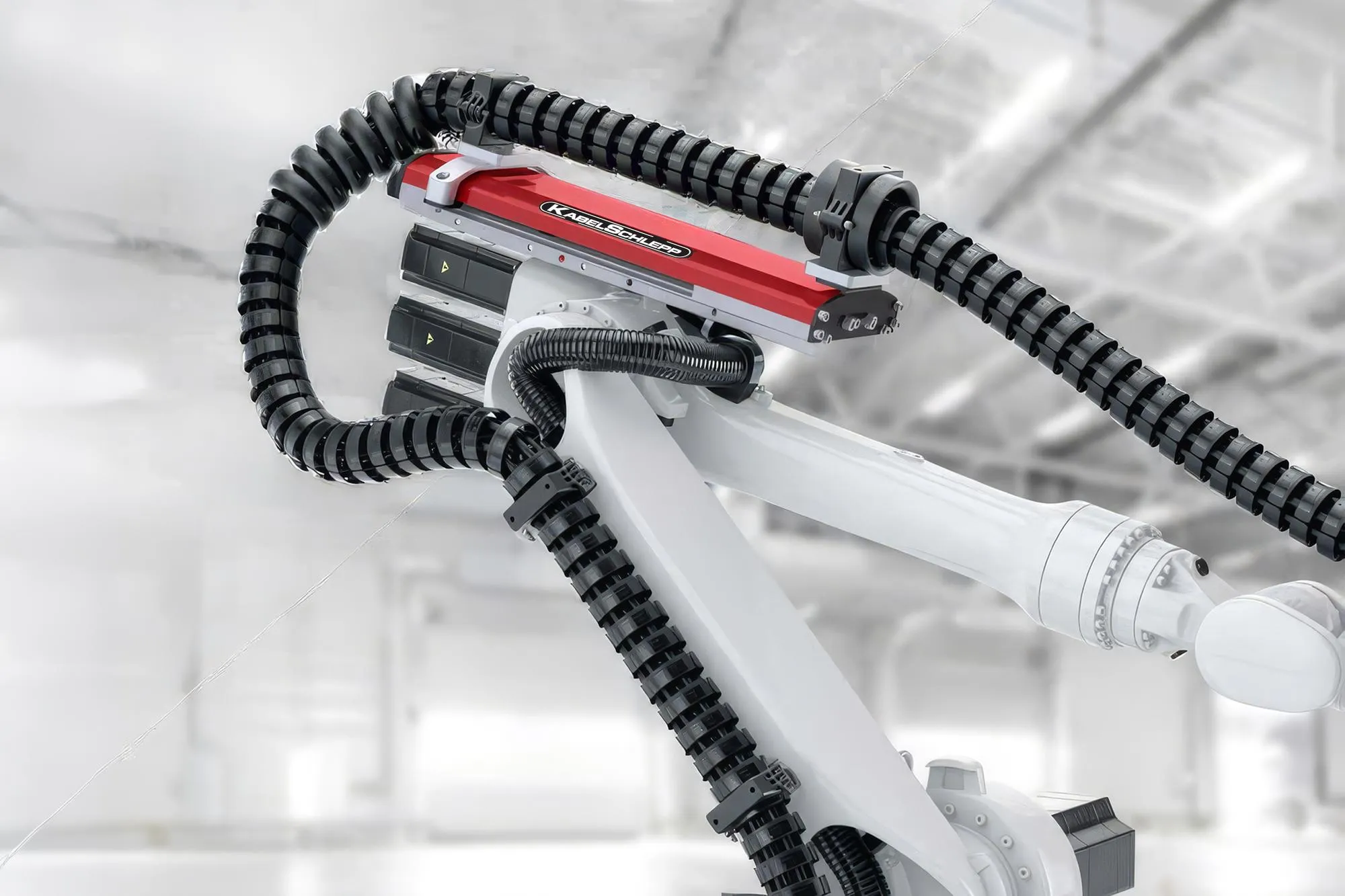
To overcome these multi-axis motion challenges, the Tsubaki KabelSchlepp Robotrax System provides a specialized three-dimensional cable carrier engineered specifically for complex robotic motion.
Conventional cable carriers often transfer operational movement stress directly onto internal electrical lines and hoses. The Robotrax system changes this dynamic through a central steel cable that runs through the core of every chain link.
The Robotrax system’s central steel cable absorbs the primary tensile loads and preserves conductor integrity, dramatically extending cable service life.
When robot arms undergo rapid directional shifts and accelerations up to 10 g, this internal steel cable absorbs the primary tensile loads. By isolating electrical and fluid lines from pulling forces, the design preserves conductor integrity and dramatically extends cable service life. Mechanics can easily calibrate and adjust system tension using an integrated clamping piece, ensuring consistent mechanical support throughout long operational cycles.
The foundation of the Robotrax system lies in its open, single-piece plastic links featuring spherical snap-on connections on both sides. This geometry allows the carrier to flex smoothly across three axes, providing radial rotation of up to ±450 degrees per meter depending on the model size.
To optimize internal organization, carrier links contain up to three distinct chambers.
Source link