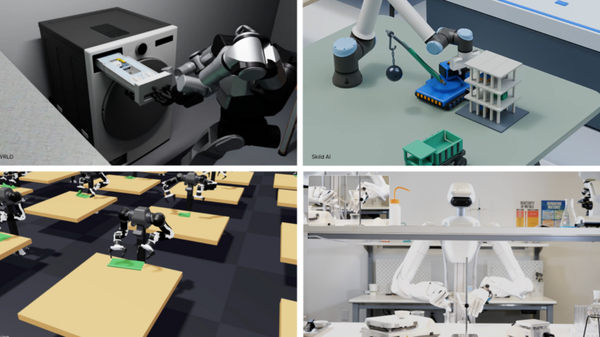
Simulation, which has long been the proving ground for robots learning to walk, roll and hop, is now helping researchers teach robots tasks that require a finer touch: aligning gears, connecting cables and assembling small components.
The shift from locomotion to manipulation is taking center stage at this week’s Conference on Robot Learning (CoRL) in Austin, Texas, alongside the rise of agentic robotics — a new paradigm that integrates frontier agents to create interpretable code for physical robotics systems.
At CoRL, NVIDIA is introducing new open robotics technologies, including world action models, simulation tools, benchmarks and agentic workflows.
Two NVIDIA papers are among six finalists out of thousands of submissions for the Best Paper Awards at CoRL:
These advancements help researchers train robots on complex tasks, evaluate their performance across changing conditions and use failures to guide further learning — building the precision, adaptability and autonomy needed to move from lab demonstrations to industrial deployment.
NVIDIA is working with partners like Ambi Robotics, Bosch Research, Dexmate, Dyna Robotics, FieldAI, Flexion, Noitom Robotics, Siemens, Skild AI, RLWRLD, UC Berkeley, Walden Robotics and the University of Washington to bring these advancements to the broader robotics community.
The next level of robot autonomy requires robots to perceive their surroundings, anticipate how their actions will change the environment and execute complex, multistep tasks with a high degree of precision. World action models enable exactly that.
At CoRL, NVIDIA is introducing GR00T 2 , an open frontier world action model built on NVIDIA Cosmos.
Source link