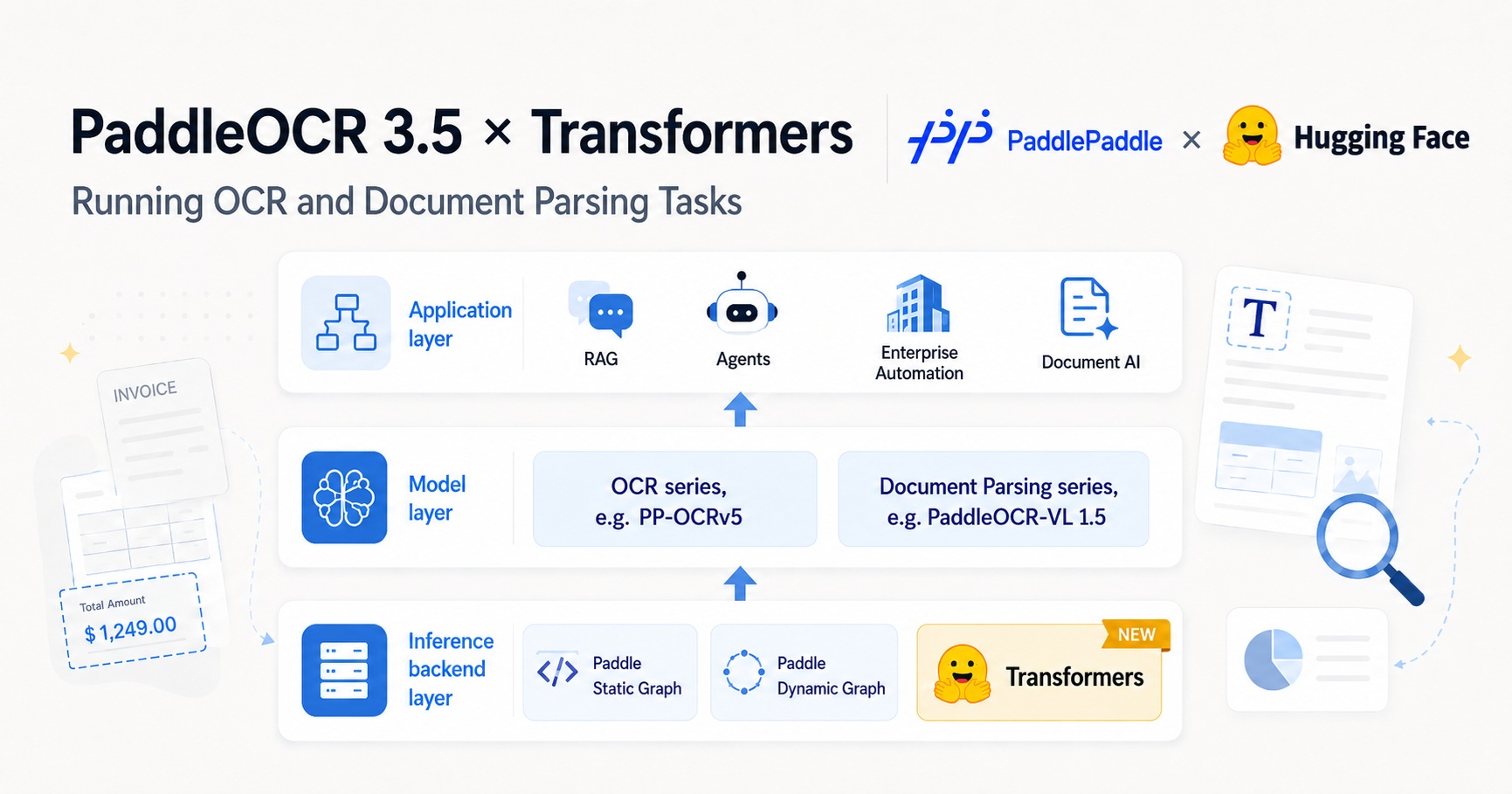
PaddleOCR continues to provide OCR model series such as PP-OCRv5 and document parsing model series such as PaddleOCR-VL 1.5, while Transformers becomes one of the supported backends for running them.
PaddleOCR 3.5 introduces a more flexible inference-engine interface. Developers can select the backend through the engine parameter and pass backend-specific options through engine_config.
This release is mainly about the inference backend layer: PaddleOCR continues to provide OCR and document parsing capabilities, while Transformers gives supported PaddleOCR models another backend option that fits naturally into Hugging Face-centered environments. The larger Document AI workflow remains in the hands of developers and application builders.
For RAG, Document AI, and document agent applications, the hard part often starts before the LLM.
Developers first need to turn PDFs, scanned documents, screenshots, tables, charts, formulas, and complex page layouts into reliable structured data. If this ingestion step is weak, the downstream LLM workflow may miss key information, retrieve the wrong context, or produce unreliable answers.
PaddleOCR helps address this document ingestion challenge by providing OCR series models such as PP-OCRv5 and document parsing series models such as PaddleOCR-VL-1.5.
With PaddleOCR 3.5, these capabilities are now easier to connect with Transformers-centered stacks. Supported PaddleOCR models can run with a Transformers backend, while PaddleOCR continues to manage the OCR or document parsing pipeline behind the scenes.
For developers, this means less integration friction and a more natural path from documents to downstream RAG, agent, search, analytics, or automation workflows.
Source link