
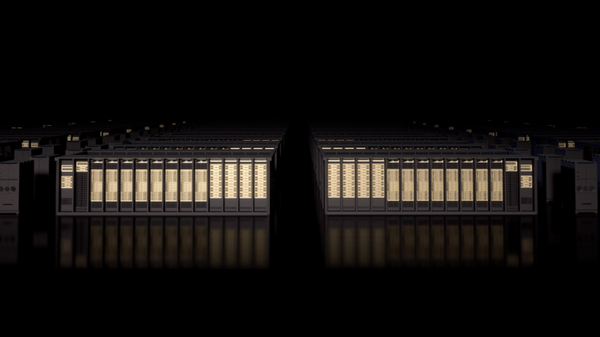
In its MLPerf benchmarks debut, with results released today, the NVIDIA Vera Rubin platform delivers leading performance across training, post-training and agentic inference.
NVIDIA swept every MLPerf Training v6.1 benchmark and, in its first MLPerf Endpoints submission, delivered more than 10x generational gains in throughput per watt for agentic AI — measuring how much agentic work a system delivers with each watt of power.
These results are just the beginning. Vera Rubin performance will keep climbing through continuous optimization of NVIDIA’s CUDA-powered software stack, so the infrastructure that customers invest in today delivers more value over time.
AI agents are now everywhere, writing code, running business workflows, answering customer questions and, as this week’s SC26 conference highlights, advancing scientific research.
Faster training means smarter agents can reach users sooner, drug discovery models can keep pace with new lab data and fraud-detection models can adapt to new threats faster.
MLPerf Training measures how fast a system can train a range of AI models to a target level of accuracy.
The NVIDIA platform was the only one with results on every benchmark this round, spanning large language models, image generation, recommender systems and reinforcement learning post-training. In its debut, Vera Rubin NVL72 delivered up to 2x more performance per GPU than the highly optimized NVIDIA GB300 NVL72 system — early results that show the pace of generation-over-generation innovation.
NVIDIA also demonstrated performance at scale. On the DeepSeek-V3 benchmark, Vera Rubin NVL72 scaled from 256 to 1,024 GPUs with about 97% efficiency: quadrupling the GPUs cut time to train from 16 minutes to about four.
Source link





