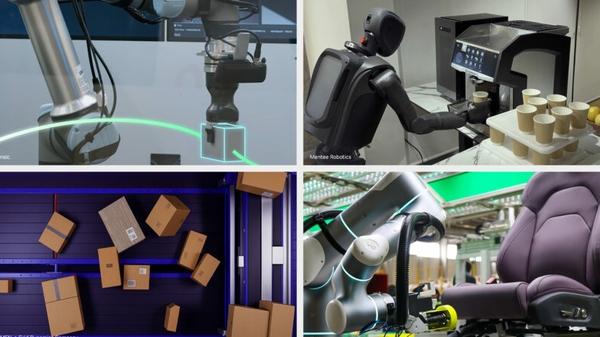
To build and deploy sophisticated robotics applications that can perceive, reason and act in dynamic environments, developers need new physical AI models and tools.
The ROS open framework is a project from Open Robotics that helps humans build robots. NVIDIA Isaac ROS 5.0 — a collection of GPU-accelerated packages built on ROS, released today at the ROSCon conference in Toronto, Canada — helps humans and AI agents build robots together.
The release introduces new agentic workflows and platform support to help developers build, customize and deploy robotics applications faster.
ROS provides the open source foundation for much of modern robotics development, giving developers common tools, libraries and standards for building and connecting robot applications.
NVIDIA Isaac ROS brings NVIDIA accelerated computing, physical AI models and production-ready libraries to the nearly 1.3 million ROS users, helping developers build high-performance robotics applications using free, familiar, open source tools.
AI agents are changing how software is built, helping developers automate repetitive tasks, navigate complex codebases and move from ideas to working applications faster. Isaac ROS 5.0 brings these capabilities to robotics development.
Isaac ROS 5.0 introduces support for ROS Lyrical and Ubuntu 24.04, giving developers a path to adopt the latest ROS platform while continuing to accelerate demanding robotics workloads with NVIDIA accelerated computing. NVIDIA worked with the Open Source Robotics Alliance to contribute a standard data-handling interface to ROS Lyrical that helps robotics software work efficiently across different computing hardware, including GPUs.
Available to the entire ROS community, it gives developers a consistent way to accelerate demanding robotics applications, with CUDA providing a working example for GPU acceleration.
Source link