But turning accelerated computing’s potential into scientific progress — modeling climate systems, designing molecules, simulating materials and more — depends on more than breakthrough technology. Especially for smaller labs, early-career scientists or science-based startups, the hardest part of research can be everything that comes before the science: assembling tools, finding compute and building the expertise to use both.
At the AI in Science Summit in Dublin today, the European Commission launched the AI in Science Enablers Initiative, a shared framework connected to RAISE — the Resource for AI Science in Europe — that brings private-sector support closer to Europe’s research community.
“Europe’s ambition in AI in science can only become reality if we bring together the strengths of our research community, industry and other partners,” Ekaterina Zaharieva, European Commissioner for Startups, Research and Innovation. “Through the AI in Science Enablers campaign, we are turning this ambition into concrete commitments that give researchers access to the tools, expertise and resources they need to innovate.”
NVIDIA has released more than 250 open models, 250 open datasets and over 1,400 open source software projects spanning large language models, healthcare, robotics, climate science, physical AI, autonomous vehicles and scientific research. The models and datasets are available on Hugging Face and GitHub.
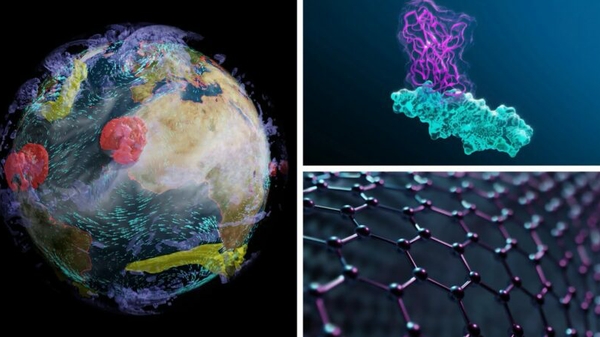
Building on this open ecosystem, researchers can build agentic reasoning capabilities with NVIDIA Nemotron — a family of architectures, open weights, open source models, training data and recipes — and scientific software including NVIDIA BioNeMo Agent Toolkit , NVIDIA PhysicsNeMo libraries, NVIDIA Earth-2 models and NVIDIA ALCHEMI NIM microservices to accelerate research across biology, chemistry, molecular design, weather and climate, energy, engineering, physics and material sciences.
Source link