World foundation models offer a different path. Instead of manually authoring every object and physical interaction, they learn visual dynamics directly from synchronized video and robot kinematics. NVIDIA's Cosmos-H-Surgical-Simulator demonstrated this approach by generating future surgical video from an initial scene and a sequence of robot actions. It enabled faster-than-physical evaluation and synthetic data generation across the Open-H-Embodiment ecosystem.
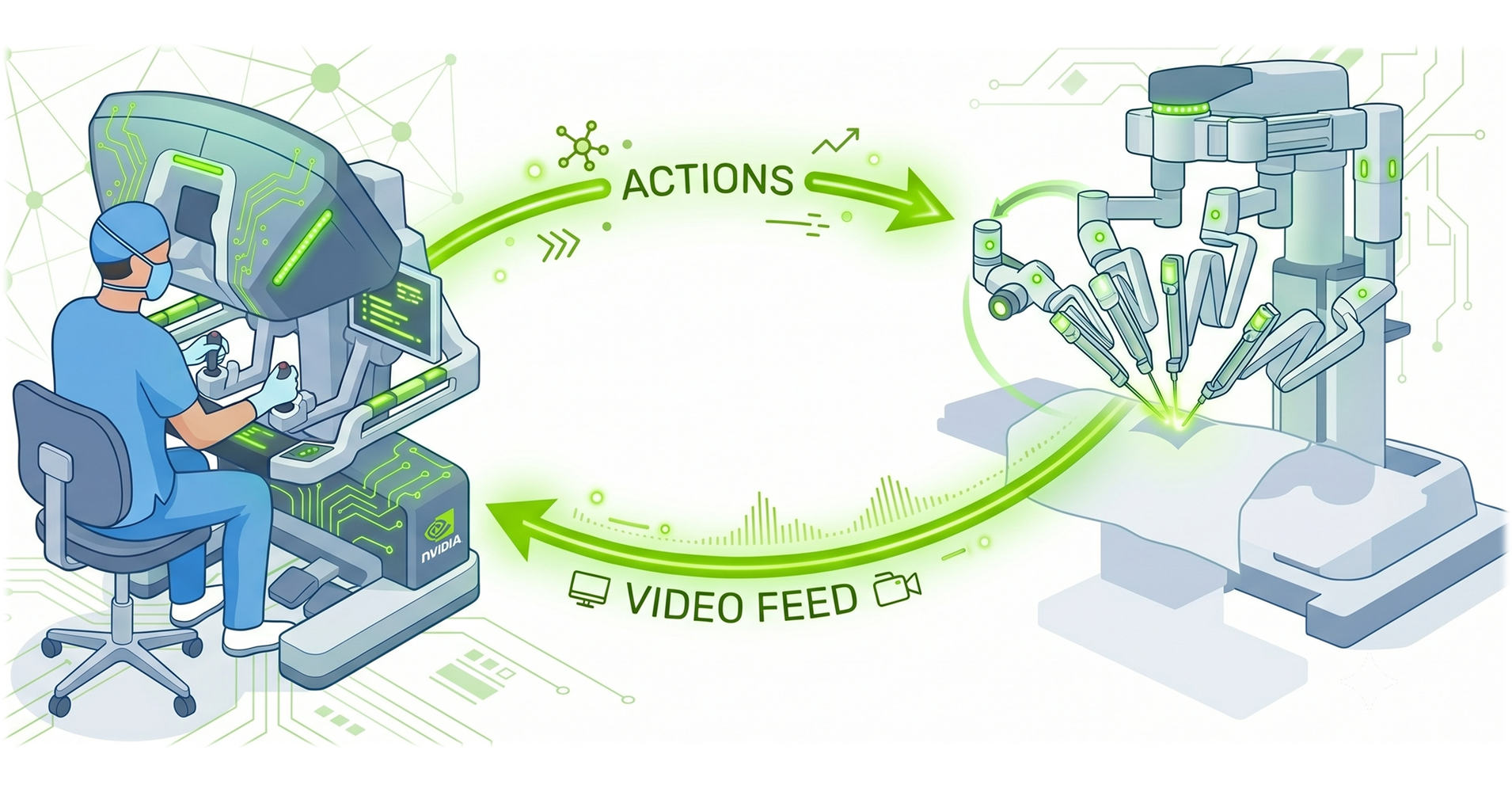
Today, we are introducing the next step: Cosmos-H-Dreams, a real-time, action-conditioned generative simulator for surgical robotics. Cosmos-H-Dreams distills the capabilities of Cosmos-H-Surgical-Simulator into a causal, few-step student model and serves it through FlashDreams, NVIDIA's accelerated streaming-inference library. Running on a single NVIDIA RTX PRO 6000 GPU, the result is an interactive environment that a person or a learned policy can control in a closed loop.
Cosmos-H-Surgical-Simulator is an action-conditioned world foundation model built on NVIDIA Cosmos-Predict2.5-2B and post-trained on the Open-H-Embodiment dataset. Given a surgical context frame and a future robot trajectory, it generates video showing the likely visual consequences of those actions. This makes it useful for offline policy evaluation and synthetic data generation. A recorded or policy-generated trajectory can be sent to the model, the corresponding rollout can be generated, and the result can be inspected or scored without repeatedly executing the motion on a physical robot.
Cosmos-H-Dreams moves the model into the real-time regime. Starting from the multi-embodiment surgical priors learned by Cosmos-H-Surgical-Simulator, we specialize the model for da Vinci Research Kit (dVRK) tabletop suturing and distill it into a causal student that generates the scene autoregressively.
Source link