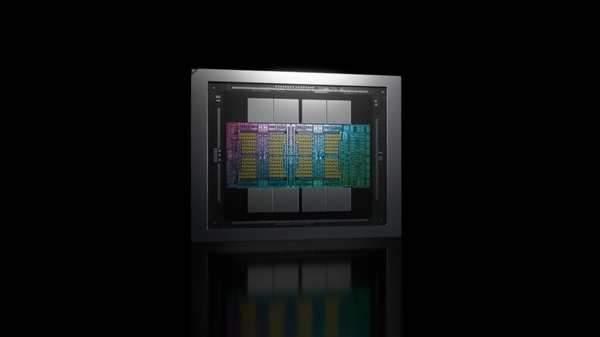
Announced today at SC26, NVIDIA Rubin HPC is a new GPU in the NVIDIA Vera Rubin platform designed to accelerate simulation and data processing for science, engineering and analytics workflows.
As agents help scientists and engineers explore more candidate materials, molecules and designs, they rely on simulations to test those ideas and guide their next steps. Rubin HPC will accelerate those simulations, shortening the path from exploration to scientific discovery and industrial design.
The Rubin HPC GPU features a record number of CUDA cores — more than 50,000 on a single GPU — as well as a sparse data acceleration capability that keeps those cores fed with data, and accelerates GPU-to-GPU connectivity with seventh-generation NVIDIA NVLink interconnect technology.
Scientists and engineers rely on simulation to understand complex systems before committing to experiments or physical prototypes. Working with agents, these teams can explore more candidate materials, molecules and designs. This increases demand for the GPU-accelerated simulations needed to evaluate those ideas and guide next steps.
“For agents tackling science and engineering, faster simulation means faster discovery,” said Ian Buck, vice president of hyperscale and high-performance computing at NVIDIA. “Rubin HPC accelerates the simulations agents use to test ideas and guide their next steps, helping scientists and engineers explore more possibilities and bring breakthroughs closer.”
Across climate models, engineering simulations, genomic analysis and financial risk, scientific computing workloads take a similar shape: an application reaches into an immense dataset, gathers a handful of scattered values, calculates a result and repeats this on an enormous scale.
Source link