This article has been reviewed according to Science X's editorial process and policies. Editors have highlighted the following attributes while ensuring the content's credibility:
In electronic devices, irregular fluctuations in signals are generally referred to as "noise." Because noise interferes with accurate information processing, conventional semiconductor technology has mainly treated it as something to be reduced or eliminated.
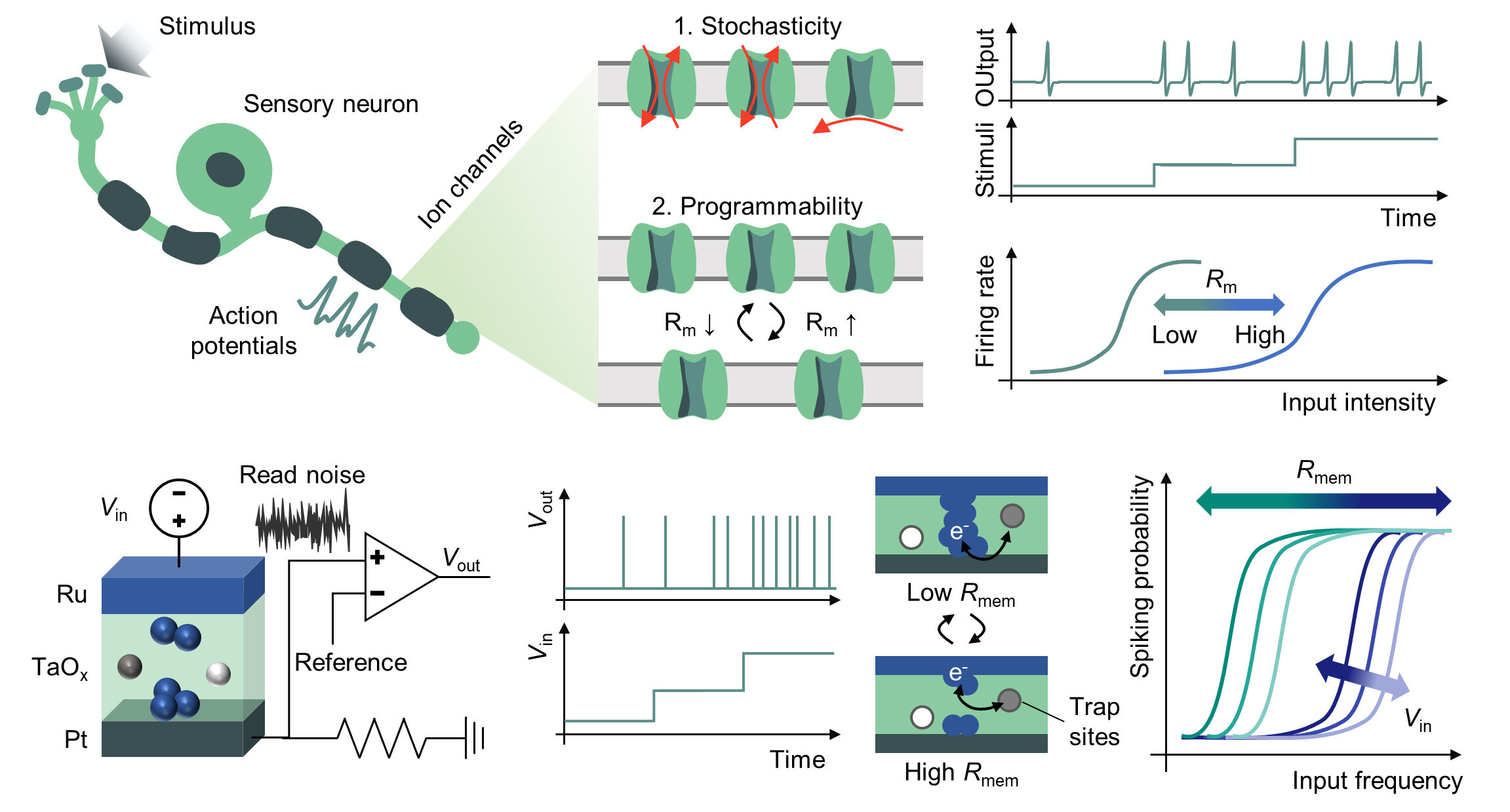
However, neurons in the human brain do not respond in exactly the same way every time, even to the same stimulus. Tiny internal variations in neurons change when and how often neurons fire, and this probabilistic operation is one of the brain's key information-processing features.
Inspired by this, KAIST researchers have developed a next-generation semiconductor technology that does not remove current noise generated in memristors, but instead tunes it to a desired level and uses it to process different types of signals.
A research team led by Professor Kyung Min Kim from the Department of Materials Science and Engineering has developed a new neuromorphic neuron technology that uses noise generated in semiconductor devices for information processing, enabling selective encoding of time-series signals across different frequency bands.
The study was led by Dr. Do Hoon Kim from the Department of Materials Science and Engineering as first author and was published in Advanced Materials.
In general, noise generated in semiconductors is regarded as an obstacle to accurate signal processing. For this reason, most electronic devices are designed to reduce or eliminate noise as much as possible.
The human brain, however, works differently.
Source link