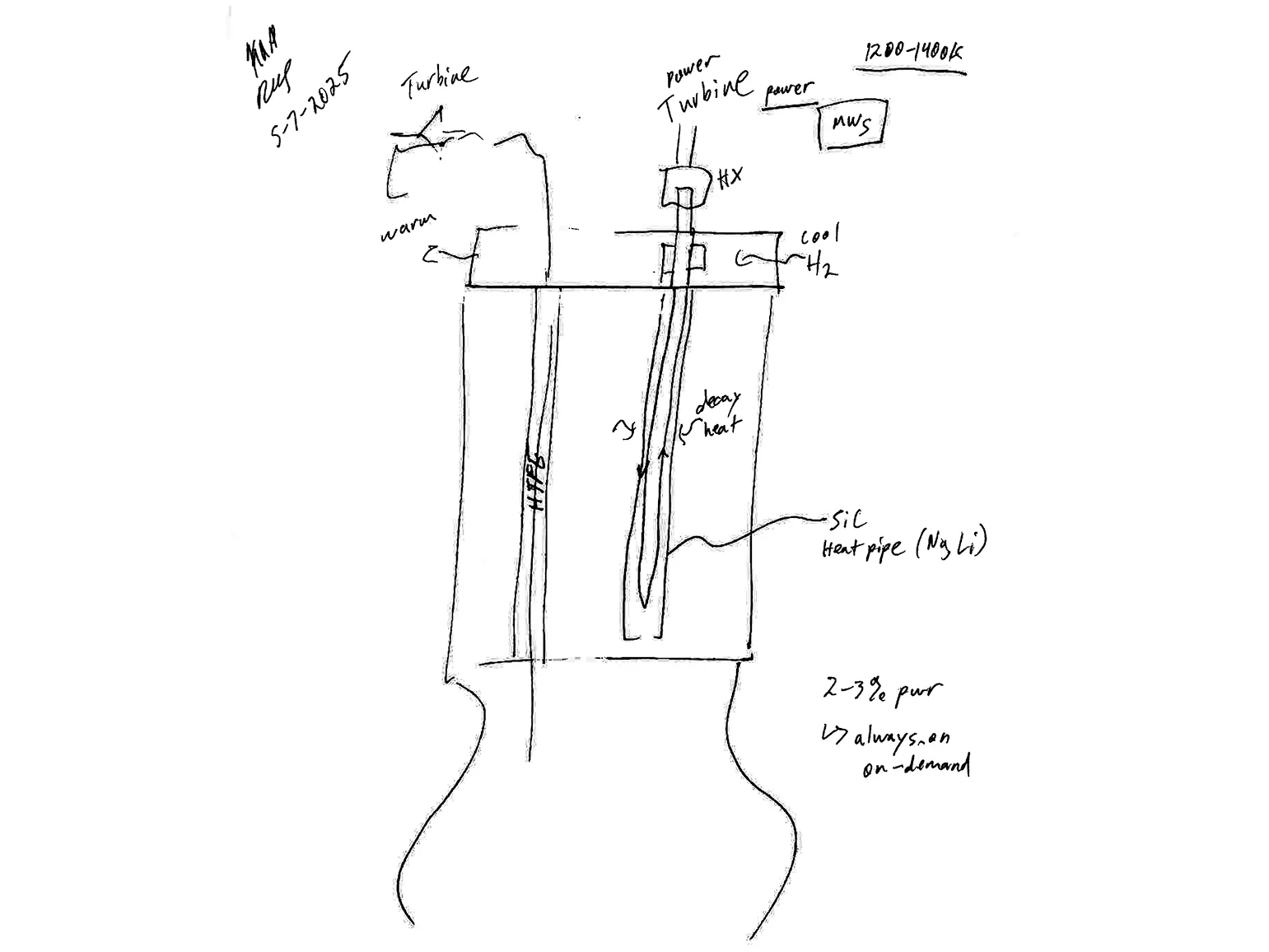
One day in 1982, Joseph “Rod” Canion and two colleagues from Texas Instruments sat down at the House of Pies in Houston and used a placemat to sketch out what would become Compaq’s portable PC. In 1996, Felix Zandman, founder of Vishay Intertechnology, dined at Husker Steak House in Columbus, Neb., grabbed a napkin and drafted a design for a power metal strip resistor, which became crucial to power-management components in industrial, automotive, and consumer applications. Now that wispy piece of paper resides at the Smithsonian’s National Museum of American History. Perhaps most famously, Robert Metcalfe, working at Xerox PARC in 1973, roughed out some early designs for what would become Ethernet, though contrary to popular belief, no napkin was involved.
Yet another napkin (see above) was pressed into service last year, when Kurt Polzin, chief engineer of the space nuclear propulsion project at NASA’s Marshall Space Flight Center, met Robert Schleicher of General Atomics Electromagnetic Systems at a conference and started talking about nuclear rocket design.
“They did the classic let’s-sketch-out-an-idea-on-a-napkin,” says IEEE Spectrum’s Special Projects Editor and our in-house spaceflight expert Stephen Cass. “This rocket engine is still at the paper-planning stage, which, to be fair, is where most of NASA’s humans-to-Mars planning has been for the last 60 years.”
Meanwhile, the world’s richest person is pushing for humans to colonize Mars in time for him to escape our hospitable blue marble for a completely barren red planet. One big problem with this idea: It takes a long time in hostile space to get there.
Source link